

HIGHLIGHTS
PROGRAM UPDATES
WoodWorks Positions Wood for Growth in Data Centers A Stronger Case for Wood in High-Hazard Zones in the 2027 SDPWS Think Wood Drives Wood’s Momentum in Higher Ed Projects Timber in the City Competition Engages 840 Students in Wood-Based Housing DesignINDUSTRY RESOUCES
FEA's Housing DashboardAccelerator City Program Expands in D.C. and New York City
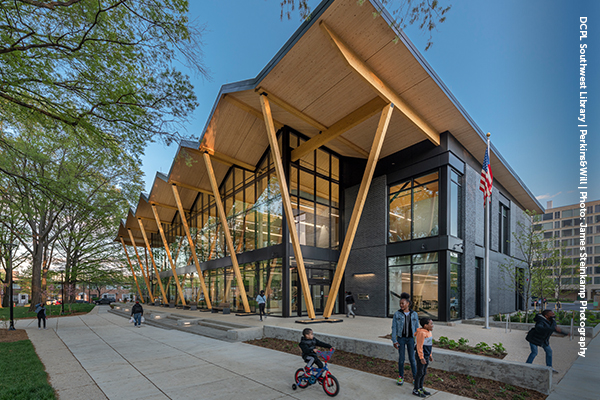
The SLB’s Accelerator Cities Program is building momentum with the announcement of the DC Mass Timber Accelerator and a third cohort of New York City’s Mass Timber Studio.
Launched by the Washington Architectural Foundation (WAF), in partnership with the SLB and with funding support from the USDA Forest Service, and U.S. Endowment for Forestry and Communities, the DC Accelerator will award $160,000 across several projects and provide technical assistance and professional education to help development teams explore mass timber construction in active projects across the District.
“D.C. has a remarkable design community and a long tradition of architecture that responds to the people and places around it,” said Kimberly Bender, Executive Director of the Washington Architectural Foundation and AIA|DC. “This program gives project teams an opportunity to bring that same level of thoughtfulness to an emerging generation of buildings, while gaining practical experience with mass timber and evaluating where it can deliver meaningful benefits.”
The New York City Economic Development Corporation also announced this month a third cohort of its Mass Timber Studio supported by the SLB and USDA Forest Service. The Mass Timber Studio has showcased a successful model for future accelerator cities and was featured in the mayor’s “Block by Block” plan to accelerate affordable housing production.
These programs and the recently announced Alabama Mass Timber Accelerator join the SLB’s growing network of Accelerator Cities, which since 2022 has invested $2.1 million in programs in Boston; New York City; Georgia; Santa Monica; and Portland, Oregon, advancing millions of square feet of potential wood construction. The program connects municipal and state leadership, code and fire officials, developers, and design teams with technical, educational, and communications support—helping active development projects advance through the critical early phases of planning and design, while strengthening the broader case for lumber as a mainstream building material in taller and larger buildings.
To learn more and connect your local city officials with the SLB for guidance and resources, contact acceleratorcities@softwoodlumberboard.org.
Program Updates
WoodWorks Positions Wood for Growth in Data Centers
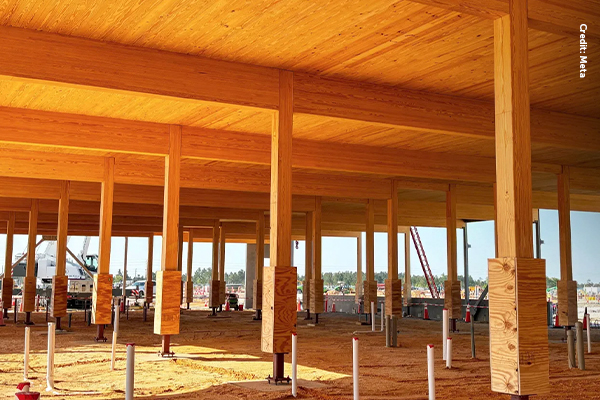
Driven by growing demand for cloud computing and artificial intelligence infrastructure, data centers are one of the fastest-growing segments of commercial construction. The segment is expected to grow by 26% in 2026 and 17% in 2027, far above the market average, and represents part of the overall office segment’s 299 MM BF annual incremental lumber demand opportunity by 2035. Meta, pictured above, is a major player in the data center space and is piloting mass timber buildings at sites in Wyoming and Alabama. WoodWorks is helping position mass timber for increased use in the data center sector with recent successes:
-
- CLT Creates New Opportunity for Hyperscale Data Centers – WoodWorks helped a major hyperscale data center team in Wisconsin justify the use of cross-laminated timber (CLT) skid platforms, establishing a repeatable pathway for wood use.
- Tour Leads to First Mass Timber Data Center – Following a connection made during a Washington, D.C., building tour, WoodWorks provided technical guidance that helped advance a technology company’s first mass timber data center prototype, creating a nationally significant demonstration project.
- Early Design Support Advances Texas Data Center – Working with a general contractor during early project planning, WoodWorks provided conceptual design guidance and construction resources that helped evaluate mass timber for a large-scale data center in Texas.
- National Webinar Features Data Center Design Leaders – WoodWorks’ national webinar, “Exploring Mass Timber for Data Center Design,” attracted 1,900 specifiers, with 72% of attendees saying they gained ideas to use wood where other materials are typical.
A Stronger Case for Wood in High-Hazard Zones in the 2027 SDPWS
The AWC has completed the 2027 edition of the Special Design Provisions for Wind and Seismic (SDPWS) standard, which has already been approved as an American National Standard by ANSI and will be referenced in the 2027 I-Codes. The 2027 edition provides design teams with additional options for light-frame wood and mass timber construction, helping to expand wood’s market share in regions with high wind and seismic demands.
SDPWS is the wood industry’s standard used by engineers and code officials for the design of wood structures to resist seismic and wind loads. As an ANSI-approved standard, SDPWS must be updated every five to six years, ensuring that the provisions keep pace with the changes in other standards. The consistent, consensus-based updates to the standard help ensure engineers and builders can rely on SDPWS with confidence when building in seismic and wind-prone regions.
Among the many significant changes in the 2027 edition, two new systems have been added, giving builders more flexibility in wood construction: the Post-Tensioned Timber Rocking Wall system and a new sheathed wood-frame High-Capacity One-Sided Shear Wall system. The changes could open up new opportunities for wood products in seismic regions like California, as well as for wood-frame buildings with lots of exterior glass—a feature in demand among architects. In addition, the AWC made several changes to the design procedures for CLT diaphragms based on the analysis of new research on full-size CLT diaphragm tests, the same research that is now shaping the proposed seismic design coefficients for CLT diaphragms in ASCE 7-28.
With the 2027 SDPWS complete, the AWC remains committed to the rigorous, science-backed process that keeps wood construction standards safe and current as it looks to finish updates to the Permanent Wood Foundation Design Specification (PWF) this year and then begin updates to the 2024 National Design Specification for Wood Construction (NDS), the 2024 Fire Design Specification for Wood Construction (FDS), and the 2024 Wood-Frame Construction Manual for One- and Two-Family Dwellings (WFCM).
Think Wood Drives Wood’s Momentum in Higher Ed Projects
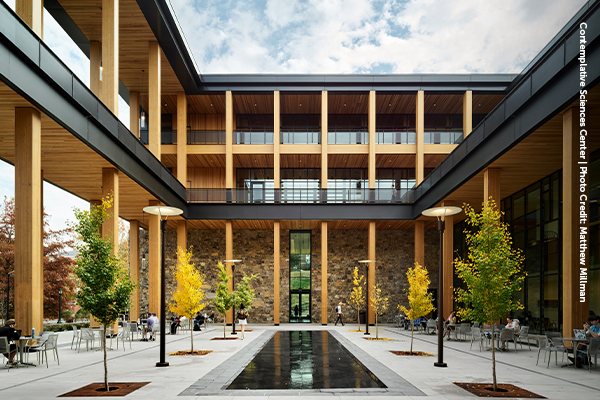
Think Wood’s recent case study of the new Contemplative Sciences Center at the University of Virginia in Charlottesville provides an inspiring example of how lumber-based structural systems can support universities’ biophilic design goals. The design by Aidlin Darling Design with VMDO Architects features 27-foot-tall, exposed Douglas fir glulam columns in a courtyard adjacent to the site’s natural glen.
“Wood is fundamental to the concept of the whole entire project,” Aidlin Darling principal Kent Chiang says. “We could talk all day long about light and air and landscaping and connection to nature through a courtyard, but it would not get there without the wood columns.”
Education construction is a high-priority segment for the SLB, with more than 3,500 buildings constructed each year and an annual incremental lumber demand opportunity of 203 MM BF. Think Wood is demonstrating the value that wood design can bring to these projects with case studies like the Contemplative Sciences Center and a recent article that featured the AIA Education Facility Design Award winners—all eight of which featured mass timber. The AIA’s awards are a strong indication that wood is becoming an important feature in contemporary education design. Think Wood’s resources capitalize on these trends to inspire and engage design teams—and high levels of engagement with campaign materials directly correlate to users being more likely to specify wood in future projects.
Timber in the City Competition Engages 840 Students in Wood-Based Housing Design
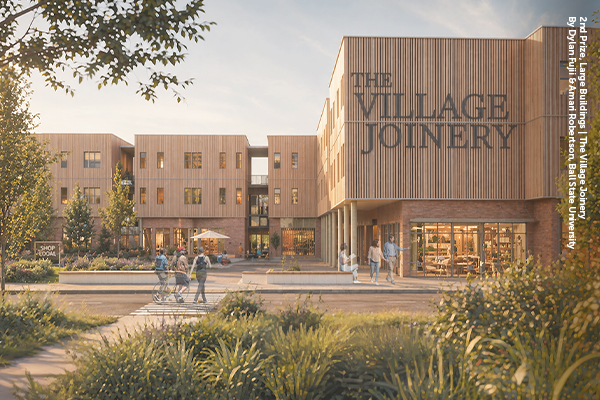
The SLB sponsored the sixth cycle of the Association of Collegiate Schools of Architecture’s Timber in the City student design competition. The 2025–2026 program attracted 840 registered students from 58 schools and ultimately received 208 project submissions—the highest total yet. The record response demonstrates the program’s reach and the strong interest among architecture students in applying wood to contemporary design challenges.
This year’s brief focused on attainable “missing middle” housing—the range between single-family homes and high-rise apartments that represents a strong opportunity for lumber demand growth. Students were asked to develop replicable wood-based solutions for a real urban site at three scales, from structures under 1,000 square feet to buildings of up to 20,000 square feet. Proposals had to balance affordability, constructability, lower-carbon performance, community context, and occupant well-being, with softwood lumber serving as the primary structural material.
Although Timber in the City is a competition, much of its value comes from how the work is developed. With 125 faculty advisors supporting participants, many entries grew out of design studios and related coursework, allowing the competition brief to serve as a ready-made teaching framework. In this way, the program brings wood directly into architecture classrooms, giving students applied experience with wood systems while helping faculty incorporate wood design into their curricula.
For decades, other material industries—including concrete masonry and steel—have supported annual student design competitions to engage future architects. SLB’s sponsorship ensures that students also have access to a prominent wood-focused opportunity and that wood remains visible within this established form of design education. By challenging students to use wood-based solutions to address a pressing housing need, Timber in the City helps position wood as a practical and scalable material before participants enter professional practice. Explore the winning submissions here.
Spotlight
SLB Programs Achieve Measurable Efficiency with AI
Artificial intelligence is already delivering measurable returns across the SLB and its funded programs. New tools are cutting costs, reducing hours of repetitive work, and turning complex data into faster, more actionable insights, freeing more resources for the industry’s central objective: growing demand for lumber. Some recent examples:
- Think Wood launched a beta AI agent that brings campaign data into a chat-based interface, reducing the time required to answer many performance questions from hours to seconds. The tool will help identify trends, strengthen KPI planning, and help direct campaign resources toward activities delivering the greatest return.
- WoodWorks is testing agents that identify potential projects and draft profiles for the WoodWorks Innovation Network, reducing manual data entry while improving consistency.
- SLB Education used AI to research all 77 ACCE-accredited construction management programs, compiling information that can help guide future education and workforce investments.
- At the AWC, 21 documented AI-assisted work products saved an estimated 184 staff hours, valued at more than $15,500. Applications included converting a complex engineering calculator to a new software program and accelerating code research.
Together, these efforts demonstrate how responsible AI adoption can lower overhead, improve insight, and make every industry dollar work harder.
Industry Resources
FEA's Housing Dashboard
FEA’s Housing Dashboard
These housing dashboards are provided compliments of Forest Economic Advisors (FEA).