

HIGHLIGHTS
SLB Programs Are Critical for Lumber Industry’s Continued Diversification and Growth
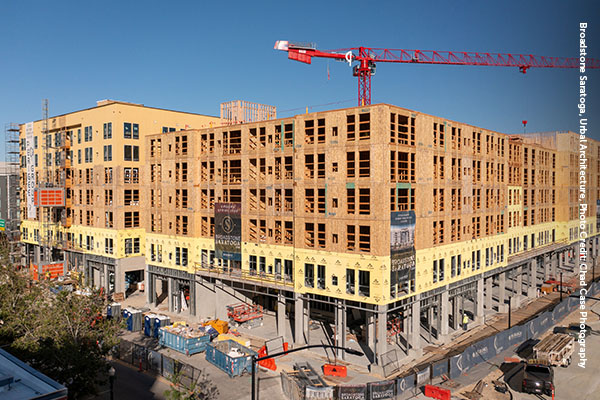
The SLB’s significant progress in increasing the market for lumber is made possible through complementary programs that advance growth for the lumber industry. The American Wood Council (AWC), Think Wood, WoodWorks, and SLB Education focus on creating, defending, and implementing building codes and standards, amplifying design and construction best practices, inspiring innovation in new performance applications, and providing technical solutions to challenges for specifiers and contractors.
The SLB is the majority funder of the AWC and WoodWorks and the primary funder of Think Wood and SLB Education, so without the industry’s continued support, these programs would require new funding sources—or they would shrink or disappear. As alternative materials intensify their competition for market share, these programs are critical infrastructure for defending and growing lumber demand, supporting the SLB’s concentrated strategy to capture 2.9 billion board feet of incremental annual demand by 2035.
Read our latest SLB Insights article to see how the SLB’s four core programs work together to drive up demand for the lumber industry.
Program Updates
Protecting Lumber’s Place in the Building Codes

Our industry’s voice in the code and standards development process is essential to keeping lumber products competitive and ensuring fair, safe, and accessible building codes nationwide.
The AWC plays that role every day. Its staff chair key code-development committees for the International Code Council (ICC), ASTM International, and National Fire Protection Association, ensuring the lumber industry is in the room where decisions get made.
The ICC codes are particularly influential as they are adopted across the country and changes can greatly impact the use of lumber. That’s why the AWC is an active participant in every three-year I-code development cycle, which includes multiple rounds of public comments, hearings, and voting.
This fall, the AWC is leading an important group of proposals to support consistent treatment of fire resistance ratings for wood products and fix a costly interpretation affecting light-frame platform construction. If finalized next year, these changes will lead to construction cost savings exceeding an estimated $104 million annually, making lumber a more desirable and cost-efficient choice.
Earlier this year, the AWC also defended previous code wins allowing fully exposed ceilings in mass timber buildings and secured new design options that reduce costs for mass timber construction.
As the code process continues into 2026, the AWC will remain on the front lines, reviewing hundreds of code change proposals, submitting expert feedback, and fighting for fair, data-driven standards that protect and expand lumber’s market share.
From Classroom to Construction: How Faculty Shape Wood’s Future

Tomorrow’s AEC professionals will design with the materials they learn about today. Yet many faculty teach only what they know best—steel and concrete, reinforced by decades of industry investment that kept those materials top of mind in schools.
That’s where SLB Education comes in. The program is building faculty capacity nationwide—equipping educators with the knowledge, incentives, and resources to bring wood to the forefront of their classrooms. The impact compounds year after year: One professor can influence hundreds of students over a career, shaping how entire cohorts of future professionals view wood.
Since 2021, SLB Education has hosted 11 faculty development workshops at leading universities nationwide, engaging more than 220 faculty from 170 programs across 47 states. Nearly 80% of participants have added wood-focused content within a year, reaching thousands of students annually. This fall, the 12th workshop will convene at the SUNY College of Environmental Science and Forestry, where construction management faculty from across the United States will explore the mass timber delivery process—from preconstruction through installation—with classroom sessions, hands-on fabrication, and site visits.
Workshops are only the beginning. SLB seed funding helps schools launch new courses and studios—supporting guest lectures, lumber for design-build projects, and immersive field trips that connect the forest-to-building life cycle. To date, eight studios have been funded, including the first-ever mass timber architecture studio at Carnegie Mellon University this fall semester. Students not only designed with CLT and glulam but also visited a forest, mill, and mass timber plant—experiences that generate enthusiasm and help shift institutional culture toward greater integration of wood.
To scale adoption further, the SLB has collaborated with faculty experts at Virginia Tech, Clemson, and Kent State to develop curriculum-ready teaching materials for architecture, engineering, and construction management programs. These resources give professors the confidence and content needed to sustain wood education well into the future.
Wood remains underrepresented in higher education, but that’s changing. Each workshop, new course, studio, and teaching resource compounds the impact—building a pipeline of professionals who see wood not as an afterthought, but as a first choice.
Attainable Housing LookBook Supports Lumber Market Growth in Key Segment

Light-frame construction and mass timber can both play key roles in creating housing that’s not just attainable, but also fosters community, dignity, and well-being. Think Wood’s new Attainable Housing LookBook illustrates that point for architects, developers, engineers, and builders with a deep look at seven affordable housing projects built with lumber. It also curates a suite of additional housing resources from Think Wood and WoodWorks, showing how wood can expand what’s possible in the housing sector.
To close the affordable housing gap, the LookBook says, “developers and municipalities face a complicated calculus of funding, lot availability, and speed. The following examples show how wood structural systems—be they mass timber or light-frame—can contribute to solving this crisis through cost savings, speed of construction, and the biophilic benefits of wood.”
Think Wood’s resource is an example of how the SLB’s programs will pursue high-growth market opportunities identified in the SLB’s From Niche to Mainstream strategic plan. Multifamily 1- to 8-story projects represent an annual incremental demand opportunity of 977 MM BF. To maximize immediate investor return, the SLB will focus on the refinement and optimization of existing funded programs, initiatives, and partnerships to ensure the full value proposition for lumber is realized across multifamily segments.
WoodWorks’ Technical Resource Library Turns Expertise Into Market Growth

WoodWorks’ market growth strategy is simple and effective. Staffed with design and construction experts, the program provides free project support, a robust nationwide education program, and hundreds of technical resources—all to help teams expand their use of light-frame and mass timber.
Beyond one-on-one support, a suite of technical resources enables WoodWorks staff to streamline the time and effort needed to support individual projects. The depth of WoodWorks’ library can be seen in materials that range from expert tip articles and technical papers to manuals and design examples. The program’s case studies go a step further, pairing real-world stories and interviews with practical insights on overcoming challenges and using lumber for nontraditional and larger building types.
Two resources exemplify the “how to” practicality of WoodWorks’ library:
- Five-Story Light-Frame Wood Structure Over Podium – WoodWorks will release this 70+-page design example in conjunction with a two-part webinar in November. The design of light-frame-over-podium buildings is an important education area as WoodWorks helps teams pursue larger light-frame projects across the United States. In preparation, the program recently released two expert tips on aspects of shear wall design, with a third coming soon.
- Structural Design of Mass Timber Elements: Gravity Design Examples – Equal parts structural analysis and design example, this document lays out a step-by-step design process for mass timber structural framing systems subject to gravity loads, including CLT, NLT, DLT, and glulam. It is intended to help readers understand what is involved in the structural design of a mass timber project and build structural skills.
These design examples complement a growing collection of resources for developers, architects, and contractors on priority topics across the building life cycle. Today, the WoodWorks library provides more than 225 resources, downloaded by nearly 260,000 professionals since 2020—a testament to the program’s practical impact and industry reach.
Spotlight
The SLB Targets Growth in Diverse Mix of Lumber-Based Building Systems in 2.9 BBF Strategy

The SLB’s recently approved strategic plan sets a bold target: 2.9 BBF in new annual lumber demand by 2035. To reach it, we are increasing investments in high-growth segments—multifamily, attainable and affordable housing, education, offices, and warehouses—where lumber offers compelling economic and environmental value propositions. Achieving growth in those segments will require a diverse mix of lumber products and structural systems.
- Light-frame: Light-frame projects of 1-8 stories represent the largest opportunity at 1.16 BBF, with Forest Economic Advisors forecasting 65% to 75% of wood use in 1- to 8-story apartment buildings, dormitories, and hotels/motels to be light-frame.
- Light-frame with CLT decking: Hybrid structural systems with light-frame walls and mass timber floor and roof panels make the best use of light-frame’s cost efficiency and mass timber’s beauty. They represent an opportunity of 396 MM BF.
- Mass timber with CLT decking: Full mass timber buildings represent an opportunity of 445 MM BF. This construction type has potential in nonresidential and taller multifamily projects, with the highest potential in 5-8 story offices.
- Steel post and beam with CLT decking: Combining the sustainability of wood and the strength of steel, steel-timber hybrid structures offer a pragmatic solution to reduce a building’s carbon impact, especially in 9+ story buildings, with a volume opportunity of 687 MM BF.
- Steel structure with mass timber walls: Primarily an option for warehouses—a segment with substantial potential but high barriers—this structural system represents an opportunity of 185 MM BF.
Check out our infographic to learn more about how the SLB will prioritize its investments to achieve 2.9 BBF of new incremental lumber demand.