

HIGHLIGHTS
PROGRAM UPDATES
Removing Barriers to Wood Education by Engaging Architecture School Administrators Think Wood Highlights Lumber’s Potential for Industrial Buildings WoodWorks Addresses Contractor Knowledge Gap Strategic Partnerships: The AWC Joins NIBS Webinar to Educate on Construction Fire SafetyINDUSTRY RESOUCES
FEA's Housing DashboardSLB Continuance Referendum Postponed Until Late 2026
The USDA Agricultural Marketing Service has postponed the SLB’s continuance referendum until two rulemaking actions recommended by the Board in March 2025 (addressing the net nominal issue and adding a seat to the U.S. South region) are complete. AMS estimates the rulemaking will be complete between September 2026 and March 2027. For more information, contact AMS Marketing Specialist Katie Cook at katie.cook@usda.gov.
USDA Announces 2026 Appointments to the Softwood Lumber Board

The USDA recently announced the appointment of six members and four alternates to serve on the Softwood Lumber Board. The three regional alternate seats and public member and alternate seats are new for 2026.
“We are thrilled to welcome these new Board members, alternates, and public representatives to the Softwood Lumber Board,” said Fritz Mason, President of Lumber at Georgia-Pacific and Chair of the SLB. “Their collective experience, industry leadership, and passion for wood products reflect the strength and diversity of our sector, and we look forward to the insight and energy they will bring to our work.”
The appointed Board members are:
Sean Peter McLaren is President and CEO of Vancouver, British Columbia-based West Fraser. He starts his first term representing the Canada West, Large seat. McLaren has been with West Fraser since 2005, beginning as a sawmill General Manager. He is also the Board Chair of the American Wood Council.
Sonja Neiman is Community Relations Director and Shareholder of Hulett, Wyoming-based Neiman Enterprises. She starts her first term on the Board representing the U.S. West, Small seat. Neiman previously founded Merryman Spinal and Sports and serves on the Board of the University of Wyoming Alumni Association.
Alden Robbins is Vice President of Searsmont, Maine-based Robbins Lumber. He represents the Northeast and Lake States region, which he also represented as an original Director of the Softwood Lumber Board, serving until 2019. He has worked nearly every position from forklift operator to sales and has served on the Board of the North American Wholesale Lumber Association and as Chair of the Northeastern Lumber Manufacturers Association.
Brian K. Chaney is Senior Vice President of Wood Products for Seattle-based Weyerhaeuser. He fills the vacant U.S. South, Large seat, serving through December 31, 2026. Chaney has more than 28 years of experience throughout Weyerhaeuser’s product lines and geographies, and he previously served on the SLB’s Finance Committee.
Richard K. Stanley is the President and CEO of Brewton, Alabama–based T.R. Miller Mill Company. He was reappointed for a second term representing the U.S. South, Small seat. Stanley has served as the First Vice Chairman of the American Wood Council Board of Directors. He is also a member of the Southeastern Lumber Manufacturers Association and previously served on the SLB’s Industry Relations and Governance Committee.
Troy Harris is Managing Director of the Atlanta-based real estate firm Jamestown. He serves as the SLB’s first public member—intended to be a person with experience in architecture, engineering, construction, development, or other related sectors that would bring a supply chain perspective to the Board. Harris has 30 years of experience in timberland management and was also instrumental in the development of the mass timber Ponce City Market in Atlanta. He is also Chairman of the Georgia Forestry Foundation.
The alternate Board members step in for an absent regular member, fulfilling the role with the same powers and duties, ensuring Board continuity. They also participate and provide input, but are not eligible to vote, when the regular members are present. Newly appointed alternate members are:
- Mark Alan Richardson, Executive Vice President of Wood Products for The Westervelt Company (U.S. South alternate, initial term 2 years)
- Steven Hofer, President and CEO of Western Forest Products (U.S. West alternate, initial term 3 years)
- Thomas Alexander Mende, Chief Sales Officer of Binderholz Timber (Importer, initial term 4 years)
- Derek Ratchford, CEO of SmartLam (Public member alternate, initial term 3 years)
The new industry alternate appointees will serve staggered terms, and the remaining appointees will serve three-year terms beginning January 1, 2026, and ending December 31, 2028.
Program Updates
Removing Barriers to Wood Education by Engaging Architecture School Administrators

Lasting, large-scale change in architectural education requires engaging not only those who teach, but also those who determine what gets taught—and where institutional resources are invested.
In November, the SLB expanded its education strategy by sponsoring a workshop held in conjunction with the Association of Collegiate Schools of Architecture Administrators Conference at the University of Arkansas. The conference convenes the academic leaders who shape program direction across U.S. architecture schools: deans, department chairs, and directors responsible for curriculum frameworks, faculty priorities, and accreditation alignment. By engaging this audience directly, the SLB placed mass timber into conversations about core competencies, learning outcomes, and long-horizon program planning.
Rather than focusing on individual courses, the emphasis was on program-level coherence—how wood systems can be reinforced repeatedly across a student’s education. This distinction matters because faculty enthusiasm alone cannot overcome structural barriers. Curriculum requirements, accreditation pressures, and resource allocation ultimately determine what reaches students at scale. By equipping academic leaders with shared models, resources, and implementation frameworks, the SLB is helping remove those systemic barriers.
“The ‘Policy to Practice’ workshop brought together for the first time 25 academic program administrators in architecture from across the country, along with leading practitioners in mass timber architecture, to conceptualize a lower-carbon, mass timber-centered architecture education curriculum of applicable value to all programs,” says Peter MacKeith, dean of the University of Arkansas Fay Jones School of Architecture and Design. “The workshop was stimulating, engaging, and ultimately rewarding in the issues identified, options considered, and frameworks brought forward.”
By pairing faculty development with administrator engagement, the SLB is advancing an approach for wood construction adoption in architectural education that aligns institutional structures with the future needs of the building industry and the next generation of designers.
Think Wood Highlights Lumber’s Potential for Industrial Buildings

Warehouses, distribution centers, and data centers represent a significant opportunity for incremental lumber demand: just 5% market share for lumber would result in 180 MM BF of incremental demand. A new Think Wood case study highlights lumber’s potential in a related building segment: manufacturing.
United Therapeutics is a multibillion-dollar biotechnology company with 1,400 employees focusing on developing therapies for rare and life-threatening diseases. For its new 196,000-square-foot Warp-10 pharmaceutical manufacturing plant in North Carolina, the company was committed to building with mass timber to reduce the facility’s carbon footprint—even in a risk-averse industry that requires strictly regulated Current Good Manufacturing Practices.
United Therapeutics partnered with architecture firm EwingCole to design a hybrid mass timber structural system that optimizes mass timber’s construction speed and biophilic benefits for occupants. The design sets precisely controlled clean-room environments against open, timber-framed offices and circulation spaces. Think Wood’s article shows how the pharma building’s innovative design provides a warm workspace drenched in daylight and wood.
WoodWorks Addresses Contractor Knowledge Gap
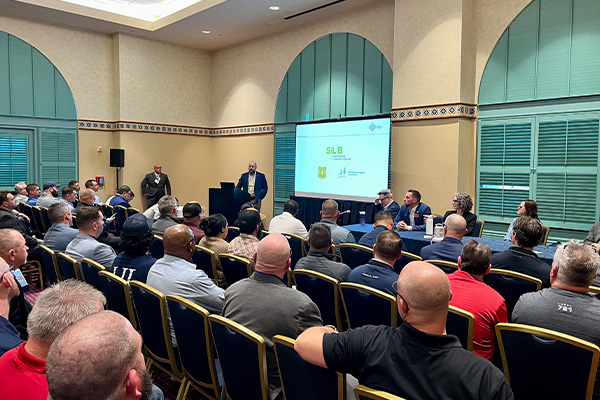
Research from WoodWorks and the SLB has identified general contractors’ lack of knowledge about wood construction systems as a primary barrier to greater mass timber adoption. One of the efforts where the WoodWorks Construction Management team is working to overcome this barrier is through the Iron Workers IMPACT Conference, reinforcing WoodWorks’ commitment to collaboration with the structural steel and broader construction community. Held in Las Vegas, the conference is expected to attract approximately 1,500 attendees, including several hundred general contractors, making it a significant platform for industry engagement.
Brandon Brooks, WoodWorks Construction Management Program Manager, is coordinating a main-stage panel focused on mass timber and structural steel, highlighting practical integration, collaboration, and real-world construction considerations. In addition, he is organizing a dedicated breakout session centered on hybrid mass timber and steel construction, bringing together WoodWorks, the American Institute of Steel Construction, IMPACT, and an experienced steel erector who has successfully completed mass timber projects (a breakout session at last year’s conference is pictured above). This session is designed to provide attendees with firsthand insights into constructability, sequencing, coordination, and lessons learned from the field.
The IMPACT Conference also enables WoodWorks and the mass timber industry to connect with new audiences, expanding construction industry awareness and interest in mass timber solutions. The conversations initiated at the conference frequently serve as a catalyst for follow-up interactions with contractors, erectors, and project teams, leading to deeper discussions around mass timber projects through targeted education, supply chain introductions, and technical assistance during bidding, procurement, and project execution. Collectively, this sustained presence underscores WoodWorks’ role in driving industry understanding, adoption, and successful delivery of mass timber and steel hybrid building construction.
Strategic Partnerships: The AWC Joins NIBS Webinar to Educate on Construction Fire Safety
The SLB sponsored an AWC webinar with the National Institute of Building Sciences (NIBS), “Understanding the Challenges of Preventing Construction Fires.” The webinar, hosted by NIBS and funded by the SLB, discussed real-world case studies, how codes and regulations play an important role in safety, and innovations that help keep people and property safe from fire.
With more than 200 individuals, including fire service, engineering, and building code professionals, in attendance, the webinar provided a valuable platform for the AWC and the SLB to strengthen attendees’ understanding of the role of codes and standards in fire safety and highlight the lumber industry’s commitment to safe construction. The AWC’s Director of Fire Service Relations, Ray O’Brocki, presented an overview of construction fire safety provisions, addressed common misconceptions, and shared best practices relevant to both the fire service and construction professionals.
The AWC’s participation demonstrates its ongoing commitment to advancing fire safety education and ensuring resources are accessible to the fire service. This webinar builds on a suite of recently released AWC tools, including the Construction Fire Safety Checklist App, which allows users to complete a site’s daily code-compliant, fire safety checklist; a relaunched, user-friendly Construction Fire Safety Coalition website; and two Mass Timber Alternative Materials and Methods Guides, one specific to Florida and one nationwide.
Spotlight
Steel Industry Awards Highlight Mass Timber and Steel’s Hybrid Potential
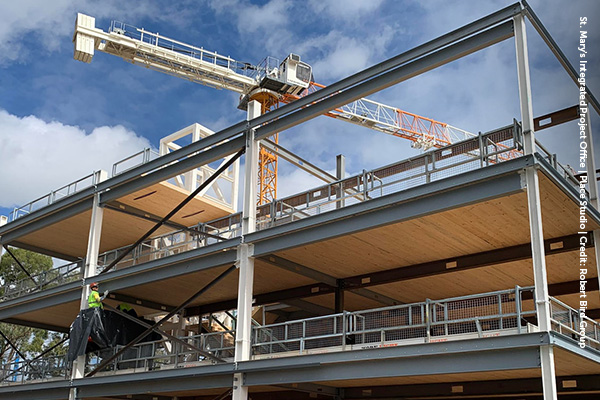
The 2025 constructsteel Awards recognized a hybrid mass timber and steel office project with the Excellence in Sustainability award—evidence that strategic collaboration between steel and wood isn’t just possible, but also commercially viable and future-facing. In the video announcing the awards, constructsteel highlights how the St. Mary’s Integrated Project Office in Sydney, Australia, combines a steel frame, CLT floors, and bolted joints so it can be dismantled and rebuilt, extending its life over five reuse cycles.
It’s the second time in the program’s three-year history that constructsteel, worldsteel’s international market development program, has recognized a wood hybrid project, with the University of Luxembourg’s research work on wood-steel connections receiving an Innovative Construction award in 2024.
The SLB’s new “From Niche to Mainstream” strategy identifies two important hybrid mass timber and steel segments as high-growth opportunities:
- Steel post and beam with CLT decking: Combining the sustainability of wood and the strength of steel, steel-timber hybrid structures offer a pragmatic solution to reduce a building’s carbon impact, especially in 9+ story buildings, with a volume opportunity of 687 MM BF.
- Steel structure with mass timber walls: Primarily an option for warehouses—a segment with substantial potential but high barriers—this structural system represents an opportunity of 185 MM BF.
The SLB has been working with the Council on Vertical Urbanism (previously the Council on Tall Buildings and Urban Habitat) and constructsteel to unlock this opportunity, beginning by establishing the Steel-Timber Hybrid Buildings Conference in 2022 and continuing with the launch of “Steel-Timber Hybrid Buildings: Case Studies,” a CTBUH research report funded by the SLB and constructsteel. WoodWorks has also been working closely with project teams to unlock new market opportunities for lumber-based construction systems by combining wood with steel, notes WoodWorks Board Director Nick Milestone, COO of Mercer Mass Timber.
“The partnership WoodWorks is building with the steel industry demonstrates how two materials can reinforce one another’s strengths, and expand the market for both,” Milestone says. “The SLB’s support is what makes that collaboration possible.”
Industry Resources
FEA's Housing Dashboard
FEA’s Housing Dashboard
These housing dashboards are provided compliments of Forest Economic Advisors (FEA).