

HIGHLIGHTS
Wood Innovations Grants Accelerate Use of Advanced Wood Products

The Softwood Lumber Board has partnered with the USDA Forest Service for a decade on the Wood Innovations Grant (WIG) program as an advisor in the Forest Service’s selection of awardees as well as providing matching funds for the program. In 2025, the SLB assumed a more significant role, serving as the program administrator responsible for managing and distributing the USDA’s award budget of nearly $2 million supporting 10 projects. This new level of partnership underscores the USDA’s trust in the SLB’s expertise and the SLB’s leadership in managing funds for projects that will have lasting impact on market growth, sustainability, and the broader wood products industry.
The 2025 program supports projects that advance the development, testing, and adoption of innovative wood products and mass timber systems nationwide. Highlights include:
- Engineering firm KL&A’s development of engineering data and design methods for NLT panels made from Colorado-sourced lumber.
- Applied research by HGC Noise Vibration Acoustics to provide code-ready data to help designers meet sound requirements with exposed wood.
- Mahlum Architects’ study assessing how exposed wood influences student well-being and performance.
- Timberlab’s fire testing on glulam beams with mechanical and electrical penetrations to develop safe, code-supported detailing methods.
“The Softwood Lumber Board sets the gold standard for identifying outcomes and demonstrating return on investment,” says Brian Brashaw, Assistant Director, Natural Resources & Wood Innovations for the USDA Forest Service. “Few industry-led initiatives can point to results as clearly as the SLB. Through disciplined strategy, strong partnerships, and measurable accountability, the SLB is expanding markets for softwood lumber while strengthening the connection between forest management, economic vitality, and long-term sustainability.”
From Momentum to Mainstream: The SLB’s 2025 Annual Report

The SLB’s 2025 Annual Report highlights the organization’s impact in expanding and protecting markets while driving measurable growth in softwood lumber demand. The SLB Annual Report is available online at softwoodlumberboard.org/annualreport.
“The SLB and its funded programs—the AWC, Think Wood, WoodWorks, and SLB Education—delivered solid results in 2025 despite a challenging construction environment, supporting the conversion of 1,536 projects, representing 62 million square feet of construction, and generating 1.5 billion board feet of incremental demand,” said SLB President & CEO Cees de Jager. “These outcomes reflect both the resilience of the SLB’s programs and the growing competitiveness of lumber-based building systems.”
In 2025, converted projects were 66% light-frame construction, 26% mass timber, and 8% mass timber hybrid construction. Since 2012, the SLB and its programs have cumulatively generated more than 16.7 billion board feet of demand, equating to an average return of 85 incremental board feet for every $1 invested.
The SLB’s new “From Niche to Mainstream” strategy targets 2.9 BBF of incremental annual demand by 2035, building on a proven record of measurable results. With a strong foundation in place, the focus now shifts to disciplined execution in a market shaped by tighter capital, fewer starts, and increased competition. Read more about the SLB’s accomplishments and disciplined strategy in the 2025 report.
Program Updates
Amazon Highlights WoodWorks-Supported Mass Timber Logistics Facility

The first large-scale owner-occupied logistics facility in the United States built with mass timber, Amazon’s new Delivery Station DII5, is now on the WoodWorks Innovation Network and was featured at last month’s International Mass Timber Conference. A keynote presentation by Amazon and Meta focused on how these companies are exploring mass timber for campuses, warehouses, and data centers. Amazon also discussed its facility in depth during a panel discussion that included project team members from ZGF Architects, KPFF, Graycor, and Sterling Structural.
WoodWorks served as a technical advisor on this project, with multiple staff providing support. Delivery Station DII5 sets a new benchmark for sustainable industrial construction, incorporating 40 carbon-reduction initiatives and demonstrating how incorporating lumber-based structural systems can reduce the embodied carbon of warehouses and contribute to occupant well-being through biophilic design. It includes a hybrid panelized wood roof system and CLT walls in the warehouse and two 550-foot-long mass timber canopies on the building’s exterior. Mass timber is also used extensively in the office block. The project includes more than 1,100 CLT panels manufactured from U.S.-sourced southern pine.
Warehouses are a priority construction segment in the SLB’s strategic plan, with an incremental volume opportunity of 178 MM BF at just 5% market share, with significant upside as penetration increases. As a trusted advisor to several companies exploring wood solutions nationwide, WoodWorks is laying the groundwork for broader industrial adoption, positioning lumber for growth as warehouse and data center construction gains momentum nationwide.
Think Wood Attracts Builders and Contractors with Live Demos

The contractor-focused JLC Live in Providence, Rhode Island, and the 2026 International Builders’ Show (IBS) in Orlando marked a deliberate shift in Think Wood’s trade show strategy. Rather than a primarily educational presence, Think Wood transitioned to a more experiential model by incorporating live, hands-on demonstrations led by a professional carpenter.
By engaging builders and contractors in person, Think Wood reinforces what makes lumber familiar, reliable, and trusted on the jobsite, while also reminding audiences what true craftsmanship with wood looks like at a high level. The live demonstrations elevate perceptions of wood by showcasing the speed, precision, and versatility achievable in skilled hands. In a crowded exhibit hall, this approach increases booth traffic by stopping attendees who might otherwise pass by and generates more substantive conversations.
IBS also continues to serve as a coordinated platform for regional industry partners. Participating associations included the Southern Forest Products Association, Western Red Cedar Lumber Association, Western Wood Products Association, and Northeastern Lumber Manufacturers Association, with NELMA taking a lead role in organizing the demonstration program. Unified participation strengthens industry visibility and avoids fragmented representation.
“The SLB’s invitation for NELMA to help shape this new experiential trade show strategy made a real difference,” said Jeff Easterling, President of NELMA. “Engagement was dramatically stronger than in previous years—more conversations, better conversations. IBS is our most important annual event with national builders, and working alongside the SLB amplifies our reach and relevance in ways we simply couldn’t achieve alone. Our programs align naturally, and we’re looking forward to making an even bigger splash next year.”
WUI Standards Development Protects Access to Wood Construction
The American Wood Council protected market access for wood products in wildfire zones through its engagement on wildfire-resilient construction standards.
Over the past two years, the International Code Council’s Multi-Hazard Resiliency for Residential Construction Standards Committee has been developing the ICC 605 Standard for Residential Construction in Regions with Wildfire Hazard. Early in the process, the AWC raised concerns that ICC 605 would overlap significantly with the International Wildland-Urban Interface Code (IWUIC), which risked causing confusion and creating contradicting requirements. At that time, ICC staff stated that ICC 605 would be independent from the IWUIC.
However, after two years of work and a draft standard in hand, the ICC Board reversed course in late 2025, ending the formal development of ICC 605 because it would have included conflicting and competing provisions with the IWUIC. This outcome aligns with the AWC’s initial concerns that ICC 605 would conflict with the IWUIC.
Throughout the process, the AWC worked to ensure that draft provisions remained performance-based, technically sound, and free from unjustified material restrictions. With the ICC Board’s ruling, the draft provisions in ICC 605 have now been given to the ICC Fire Code Action Committee to review for potential inclusion in the IWUIC. As an FCAC member and participant in the initial ICC 605 development, the AWC is well positioned to continue guiding how the IWUIC evolves and to ensure the performance of lumber is recognized and protected.
The IWUIC, along with other codes and standards related to wildfire resilience, are critical areas for the AWC to continue to stay involved in, as these codes and standards directly affect the use and acceptance of wood products and influence public perception of safe construction. The AWC’s ongoing leadership in this space helps ensure wood products have a strong, science-based footing in future code development.
SLB Sponsorship Connects Texas A&M Architecture Students to the Lumber Supply Chain
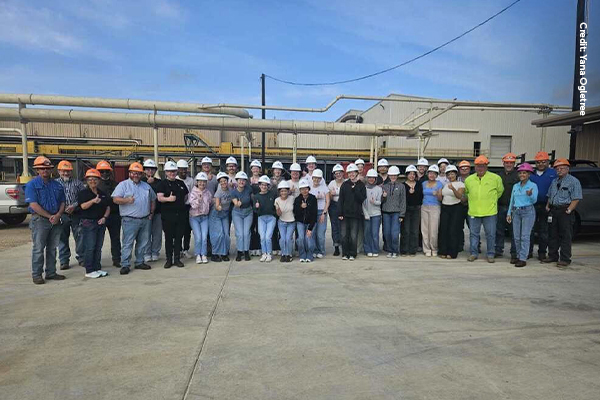
The SLB continues to strengthen the future market for lumber by supporting hands-on education that connects postsecondary students directly to the lumber industry. The SLB recently sponsored a field trip for 32 architecture students enrolled in a senior design studio at Texas A&M University led by Professor James Tate. The studio, titled Deciphering Timber, focuses on the research, design, and visualization of wood-based structural systems, with an emphasis on parametric modeling, AI-assisted workflows, and repeatable wood-based housing solutions.
Students visited multiple facilities across the lumber supply chain during the two-day field trip. Stops across multiple Texas cities included the Steely Lumber sawmill in Huntsville, the Texas A&M Forest Service office building in Hudson constructed with regionally sourced southern yellow pine glulam and CLT, the Georgia-Pacific sawmill in Pineland, and the Sterling CLT manufacturing facility in Lufkin. The experience exposed students to the full lifecycle of wood products, from forest to finished structural system, while reinforcing the role of lumber in modern construction.
Student feedback underscored the value of the experience. “Visiting the facility and seeing the lumber being processed and manufactured was an extremely helpful influence on how we’ll continue to approach the design process,” one participant said. Another wrote, “Learning the process from planting trees to harvesting shows how sustainable the timber industry is.” Several students emphasized that seeing lumber production firsthand provided insights that could not be replicated in the classroom.
By supporting experiential learning, with four field trips planned for 2026, the SLB helps prepare future architects to enter the profession with direct knowledge of wood products, manufacturing processes, and real-world applications of mass timber and light-frame systems. Investments like this in education support long-term market growth by influencing the designers who will shape future demand.
Spotlight
C40 Cities Partnership Expands Accelerator Cities Initiative
A new SLB partnership with C40 Cities will help expand the SLB’s Accelerator Cities Program to municipalities throughout the United States. C40 is a network of mayors of the world’s leading cities working together to build healthier, more sustainable cities, including 14 U.S. cities that manage construction capital budgets of more than $100 billion annually. The SLB’s partnership will augment the existing Accelerator Cities model by activating multiple municipalities simultaneously through a trusted network that already maintains strong relationships with urban sustainability leaders, extending the program’s reach while reinforcing its core framework.
Chicago is a critical test case for the SLB’s go-local strategy. It is a legacy steel-and-concrete stronghold that has yet to adopt mass timber–friendly codes, making it as much a barrier as it is an opportunity. The C40 partnership can help engage not only the AEC community but also economic development agencies, fire officials, and city leadership.
“Cities are laboratories for progress, leading the way on delivering solutions for better buildings and neighborhoods for all who live, work, and play in them,” says Kate Johnson, C40 Cities Regional Director for North America. “As cities explore and adopt sustainable construction strategies, C40 is excited to partner with the Softwood Lumber Board to support local leaders in exchanging best practices, scaling solutions, and delivering results.”
Shifting from a national approach to a targeted, metro-level strategy is a central element of the SLB’s “From Niche to Mainstream” strategy implementation. Building on successful accelerator programs in Boston, New York City, and Georgia, and supported by the USDA Forest Service and U.S. Endowment for Forestry and Communities, the Accelerator Cities Program will continue to deploy strategic funding to grow high-impact urban markets in 2026. C40’s deep knowledge of city processes and decision-makers will help build a dedicated cohort of U.S. cities focused on expanding the use of lumber in the built environment.