

HIGHLIGHTS
Our Industry’s Demand Problem—and the SLB’s Vision to Address It

“Our industry is facing a demand problem.”
That reality, voiced by Ashlee Cribb, Vice President of the Wood Products Division for PotlatchDeltic and Chair of the Programs Committee for the SLB, is one that the majority of industry leaders agree on. And it’s why the industry’s support for the SLB has never been more critical. The industry sits at a crossroads: Invest now or cede ground to competitors. “Investments made through the SLB are critical to broadening and expanding the markets for our products,” Cribb says.
While challenges and economic headwinds remain, the opportunities for growth are too great to ignore. To fully realize these opportunities, the industry’s ongoing support is essential. Without the SLB and its funded programs, the progress and investments driving growth would be at risk.
In our latest SLB Insights article, we look at how the SLB is leading the charge: from helping overcome design and code barriers to pushing back against competitive materials and growing demand through education, project support, and market development.
Industry Leaders Highlight Common Goals of Lumber Industry

The softwood lumber industry has made major progress in codes and standards and in growing the market for lumber-based construction systems—but continuing investment is vital. Competitive material industries are eager to reclaim market share, and without continued industry support, hard-won gains could be lost.
To underscore the importance of this work, the SLB is spotlighting industry leaders, programs, and partners advancing market growth. This month, Nick Arkle, CEO of the Gorman Group, and Cade Warner, President and CEO of the Westervelt Company, highlight the importance of the SLB’s work to grow new markets for lumber by expanding wood construction in new building types.
“I’ve watched with great interest what the Softwood Lumber Board has achieved since its inception,” Arkle says. “Growing the demand for lumber through educating the designers and the builders, while also working on modernizing codes, has resulted in a huge positive shift in the use of wood for multiple construction solutions. It is very clear that the opportunities are boundless.”
“There’s an upward limit on how much lumber can be consumed in housing and industrial markets,” Warner says. “We need to add new demand by encouraging new uses of lumber and converting projects using other materials. The SLB accomplishes that work through the work of its programs, WoodWorks, the American Wood Council, Think Wood, and SLB Education. None of these programs are work that we could achieve on our own.”
Expect more insights from industry leaders and partners as the SLB continues to spotlight efforts to expand and protect lumber’s market share.
Program Updates
Turning Opposition Into Allies: AWC’s Fire Service Engagement
Ten years ago, Build with Strength launched with a clear goal: to block mass timber construction types from being incorporated into the I-codes and reclaim market share for concrete in residential construction. Central to its strategy was using construction fires to cast doubt on the safety of wood construction and calling into question the safety of mass timber. In response, the SLB funded and supported the AWC in launching a fire service engagement program dedicated to building relationships with the fire service and responding quickly to construction fires to prevent unwarranted attacks on wood products.
Through significant direct outreach, relationship building, education, and strategic, rapid response, the AWC turned what was once a significant threat to mass timber and our industry into a positive opportunity to educate on construction fire safety. The fire service now looks to the AWC as a leader in construction fire safety education. The AWC’s Fire Service team offers courses and speaks around the country on construction fire safety, and this has helped to build trust and confidence in our industry.
It takes years of investment of time and hard work to build relationships based on trust that can lead to these kinds of results. The SLB’s initial and continued investment has been critical to the growth and impact of this program.
Storytelling With Innovative Multifamily Projects Drives Strong Engagement
Two recent Think Wood case studies show how lumber-based construction systems can help solve design and development challenges. WRNS Studio’s mixed-use Brickline development pairs a concrete office space with light-frame wood residential units in a distinctive side-by-side configuration. While the project received coverage in architecture media, Think Wood’s article dives deeper into the structural choice, showing how light-frame wood and concrete can complement each other to optimize materials and accelerate construction timelines.
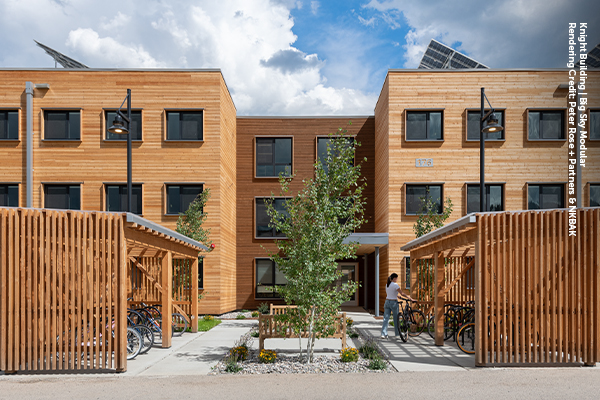
The Bucks T-4 Housing project by IDCUBED represents another exemplary structural approach. Bringing a European technology to North America, the project is the first large-scale use of mass timber modular construction in the United States. Think Wood’s article describes how the developers used the speed, precision, and simplicity of off-site fabrication of CLT modules to create 96 units of affordable workforce housing in a location—Big Sky, Montana—where affordable construction labor is difficult to come by.
By providing valuable, unique insights from design teams, these Think Wood articles drive user engagement that leads to more specification of lumber: 72% of highly engaged users across professions say they are more likely to specify wood after seeing our content. Just as important, they showcase repeatable, innovative wood solutions that can inspire future project teams.
Scaling What Works: How SLB Education Is Building a Wood-Ready Workforce

Advancing wood-focused instruction in higher education is central to the SLB’s mission to increase demand for softwood lumber. The SLB Education program supports faculty in teaching wood and channeling students’ innate enthusiasm for natural materials into technical knowledge, displacing bias and building confidence. This is the most effective way to ensure the design and construction workforce scales in step with the industry—creating lasting demand that benefits the entire value chain.
This work aligns closely with what SLB investors have been doing on their own for years: supporting local and regional institutions to advance wood education. SLB Education builds on those efforts, amplifying proven approaches and coordinating them into a national strategy. Earlier this year, the SLB surveyed investors and mass timber manufacturers to map existing engagement. The results are helping to identify where the SLB’s partners are already collaborating with U.S. and Canadian colleges and universities—and where additional, coordinated investment could strengthen the industry’s collective impact. Moreover, the findings will inform SLB Education’s priorities, improve joint outreach, and help us connect investors, partners, schools, and resources more effectively.
An example of this coordinated approach is an SLB-sponsored design-build studio at North Carolina State University, where two faculty members guided 15 architecture students in creating “The Floating Grove”—a CLT and glulam outdoor classroom pavilion and the first mass timber structure built on the NCSU campus. The project offered students hands-on experience in mass timber design, fabrication, and construction—addressing barriers that often limit wood-focused curricula.
The sponsorship reflects the SLB’s education strategy in action: scaling what works, aligning with investor priorities, and preparing a new generation of AEC professionals ready to design, engineer, and build with wood.
WoodWorks Provides Step-by-Step Guidance for Taller Light-Frame Buildings

With its latest design example, Five-Story Light-Frame Wood Over Podium, WoodWorks has once again filled a critical information gap, providing the only in-depth guidance for the seismic and wind design of buildings with five stories of light-frame wood construction over a concrete podium.
These projects offer both density and value, helping address the need for cost-effective residential and mixed-use spaces. Multifamily 5- to 8-story projects are also a high-priority segment identified in the SLB’s “From Niche to Mainstream” strategic plan, with a target market share for wood of 65% resulting in annual incremental lumber volume of 307 MM BF. Amplifying and expanding resources targeted in high-growth, high-impact sectors is a key priority for the SLB, and this design example highlights the impact these resources can have.
A building with five stories of light-frame construction has unique design and code considerations that are not widely understood. The information in this design example doesn’t exist anywhere else, including textbooks, and is detailed enough to guide a structural engineer who has never worked on this type of project. It updates a previous version that has been used extensively since 2010.
While the design example covers code provisions relevant to architects, it is primarily intended for engineers. It provides a step-by-step approach to designing a light-frame wood podium project that complies with the requirements of ASCE 7-22. Calculations included for five stories of light-frame wood construction are applicable to four stories, but demonstrate the increased attention on structural loads, shrinkage, and other design elements required for a taller light-frame building.
Spotlight
Joint Investments With USDA Forest Service Generate New Momentum for Lumber-Based Construction

At the Mass Timber+ conference in Boston last month, the SLB and USDA Forest Service announced four winning projects in the 2025 Mass Timber Competition: Building Sustainable Schools. The $1.8 million competition supports projects that accelerate the adoption of mass timber in the United States, with a dedicated focus on K-12 educational environments.
The winning projects demonstrate how biophilic design with mass timber can strengthen academic performance, improve teacher and staff well-being, and create healthier, more resilient learning spaces for students. This marks the third cycle of the competition, which has already advanced a range of innovative mass timber projects nationwide. Winning teams generate valuable data, shared learnings, and resources that will help new mass timber projects arise. Click here to check out the winning projects. [Will link to updated mass timber competition page]
The SLB also announced new joint investments in the Accelerator Cities program, also supported by the Forest Service. The city of Santa Monica’s Mass Timber Accelerator, with help from AIA Los Angeles, will support up to five early-phase development projects exploring mass timber construction. Meanwhile, Portland’s Housing Bureau has launched the Portland Mass Timber Accelerator, with support from Prosper Portland, to affordable and attainable housing studies for early-phase mass timber projects.
Since first formalizing their collaboration through a memorandum of understanding in 2015, the SLB and Forest Service have jointly invested nearly $100 million in programs and competitions that expand markets for softwood lumber and position it as a sustainable building solution. These initiatives are unlocking innovation, removing barriers, and driving measurable growth in market share.