

HIGHLIGHTS
The Next Phase of Lumber Demand Growth Starts Here
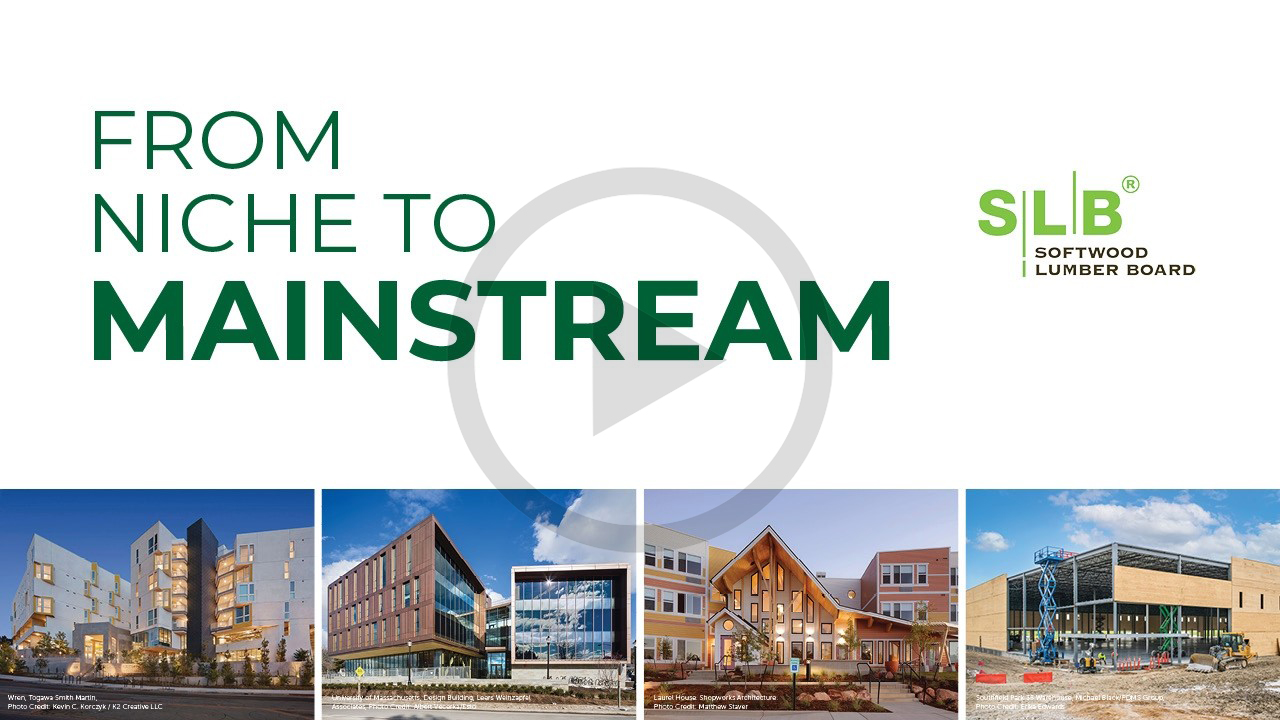
The SLB’s “From Niche to Mainstream” strategy offers a clear roadmap to 2.9 BBF of incremental annual lumber demand by 2035. With market dynamics evolving, the SLB’s approach is changing too. The SLB and its funded programs are concentrating investments in high-growth segments, prioritizing geographies with the strongest potential, and leveraging new AI and digital tools to increase precision and efficiency without increasing overall spend.
The result is a clearer, more targeted path to converting opportunity into demand. Check out this short video for a concise overview of how that strategy comes to life, and how your investment is working to grow market share.
The latest SLB Insights article fills in the details on how the SLB and its programs are implementing this new strategic approach. By focusing on creating, defending, and implementing building codes and standards; amplifying design and construction best practices; providing technical solutions to challenges for specifiers and contractors; and strengthening the value proposition for developers and investors, the SLB’s programs are building on a strong foundation and paving the way for growth.
Program Updates
WoodWorks K–12 Project Support Shifts Schools to Wood

As school districts seek cost-effective, durable solutions for campus modernization, many remain unfamiliar with how lumber-based structural systems perform in real-world applications. By delivering timely expertise, WoodWorks helps reduce perceived risk and accelerates early interest in project opportunities, creating new pathways for wood use. Recent success stories showcase this work:
- WoodWorks hosted 53 material decision makers on a tour of a Sacramento elementary school with seven new mass timber classrooms (which WoodWorks had supported), strengthening market confidence in scalable K–12 applications through peer-to-peer learning.
- A WoodWorks Regional Director guided a steel-focused design team through acoustic and structural concerns on a child education project, enabling a shift from steel to mass timber for their current project and prompting firm-wide education to build long-term wood design capacity.
- After six years of learning from WoodWorks offerings, an engineer on a high school expansion project in Texas reached out to the local WoodWorks Regional Director, who supported them in converting portions of a steel-framed design to mass timber.
Education projects represent an annual incremental lumber opportunity of 203 MM BF by 2035, with wood’s biophilic benefits and warm, inviting atmosphere providing differentiation from competitive materials. The SLB and USDA Forest Service’s 2025 Mass Timber Competition: Building Sustainable Schools awarded funding to three K–12 schools that show wood construction can outperform conventional systems in cost efficiency, durability, and community impact. WoodWorks’ direct project technical support builds on that effort, enabling K–12 design teams to overcome obstacles such as code challenges or lack of familiarity with wood, changing the way schools are built.
The SLB Immerses Future Architects in Mass Timber at Conference

The SLB continues to strengthen future demand for lumber by creating targeted opportunities for architecture students to engage directly with the professionals, products, and projects shaping today’s buildings. The SLB recently sponsored participation for 22 third-year architecture students from Cal Poly San Luis Obispo at the International Mass Timber Conference (IMTC) in Portland, Oregon, connecting these future architects with professionals across design, development, manufacturing, and construction and providing a clear view of how mass timber moves from concept to commercial reality.
The students attended IMTC at the midpoint of a mass timber-focused design studio, where they were developing proposals for a theoretical commercial building in Portland. Rather than learning about wood systems only in the classroom, students were immersed in an environment showcasing current projects, supply chain capabilities, emerging technologies, and the practical considerations that shape material decisions. This exposure helped connect academic design work to the broader industry ecosystem they will enter after graduation.
“We had the incredible opportunity to attend IMTC, where we met industry leaders to discuss the challenges and innovations happening in mass timber,” one of the participants posted on Linkedin. “After hearing [architecture legend] Kengo Kuma speak and having many informative conversations, I am feeling inspired and optimistic for the future of architecture and building technology through mass timber.”
Experiences like this help move students from academic exploration to applied understanding. By connecting future architects to wood design early in their education, the SLB is helping build the familiarity, confidence, and enthusiasm that can influence material selection decisions as these students enter practice and contribute to real projects.
The AWC Safeguards Lumber’s Competitiveness Through Engagement in Wood Standards
The AWC is protecting the safe use of North American lumber by engaging with building standards that influence market acceptance and regulatory compliance. For example, the AWC is engaged in many ASTM standards that directly influence the wood products industry, including the D07 Committee on Wood, E06 on Building Construction, and E33 on Acoustics. ASTM International sets the test methods and material performance standards that often become the gateway for product acceptance in building codes and regulatory systems worldwide.
AWC staff has had several recent successes in these committees. These include supporting the development of multiple wood standards and moving them closer to completion in D07 and chairing an E06 subcommittee that maintains standards related to panel strength testing and shear wall testing. In the E06 subcommittee, the AWC has pushed against the reapproval of an outdated shear wall test standard that had not been updated in more than 20 years. Early this year, the subcommittee voted in support of AWC’s position, meaning the standard is expected to be withdrawn. This marks an important step in ensuring the use of current, performance-based standards that better reflect modern wood construction systems.
ASTM standards, and standards of other organizations, continue to impact market access and the safe use of North American wood products. The AWC’s leadership and participation in ASTM standards ensures the provisions are performance-based and fair, ultimately safeguarding wood products’ competitiveness and reinforcing confidence in wood as a trusted, safe building material.
Office Project Case Studies Inspire Architects and Developers

With unused office space reaching record highs, how can new office developers make their projects stand out with prospective tenants or employees? In two recent project case studies, Think Wood shows that mass timber can help office projects pencil out on cost while differentiating from the competition based on tenant appeal.
At 1501 Mike Fahey in Omaha, Nebraska, architecture firm HDR worked with developer Noddle on a hybrid steel-and-mass-timber spec office project that creates the amenity-rich, sustainability-oriented workspace tenants are seeking. HDR was also the architect behind the Orange County Sanitation District Headquarters, which used a hybrid mass timber structure that met budget while cutting embodied carbon, boosting workplace wellness, and meeting sustainability goals.
It’s no coincidence that HDR was involved in both projects—the firm is making a push to increase the number of mass timber buildings in its design portfolio, going so far as to track such projects in its internal sustainability metrics. In each project, the firm carried a wood scheme and concrete and steel schemes through design—and wood won in both cases. Office projects represent an annual incremental lumber demand opportunity of 299 MM BF by 2035 in the SLB’s strategic plan. Think Wood increases architects’ and developers’ intent to specify wood in office projects and other high-opportunity segments with inspirational storytelling about the sustainability and occupant experience benefits of lumber.
Spotlight
Leadership Lessons from the Mass Timber Movement
Writing for Fast Company’s Impact Council, Steven McKay, CEO of global design firm DLR Group, uses the rise of mass timber as a lens to understand how leaders can drive innovation. Changing the narrative around mass timber from being a risky, experimental material to a vehicle for a new type of building has helped drive adoption, he writes, as has the work of leaders who embrace change.
“Mass timber adoption wasn’t inevitable,” McKay writes. “It required people across disciplines to advocate for it, test its feasibility, and prove its value, often in the face of skepticism. That kind of momentum behind a new idea doesn’t happen organically; it takes intentional leadership to steer in that direction.”
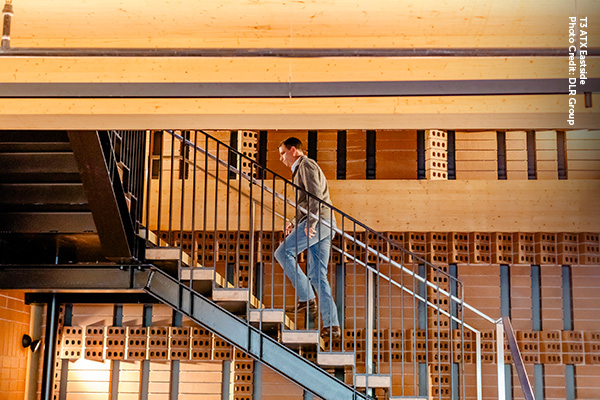
McKay’s model for innovation aligns with the SLB’s work to empower champions of wood construction to become advocates within their companies, communities, and peer networks. In fact, DLR’s work on the groundbreaking T3 (Timber, Transit, Technology) office building concept for developer Hines was originally submitted as part of the Tall Wood Building Prize competition in 2015. Today, there are 20 T3 projects completed, in design, and under construction globally.
In the SLB’s strategic plan, mass timber represents 53% of the 2.9 BBF annual incremental lumber demand opportunity by 2035. Through initiatives such as project highlights at Think Wood, design team support at WoodWorks, and the AWC’s work with local experts to support wood-friendly codes and standards, the SLB and its funded programs are enabling forward-thinking leaders like McKay and DLR to help grow a mass timber ecosystem that fosters innovation and puts lumber-based construction at the heart of the future built environment.
Industry Resources
FEA's Housing Dashboard
FEA’s Housing Dashboard
These housing dashboards are provided compliments of Forest Economic Advisors (FEA).