

HIGHLIGHTS
PROGRAM UPDATES
Project Support Converts Affordable Housing to Wood Rothoblaas Workshop Expands SLB’s Faculty Development Model AWC’s Key Wins Upheld in Final 2027 I-Codes Voting Think Wood Case Studies Boost Wood Design in High-Priority K–12 SegmentINDUSTRY RESOUCES
FEA's Housing DashboardProgram Updates
Project Support Converts Affordable Housing to Wood
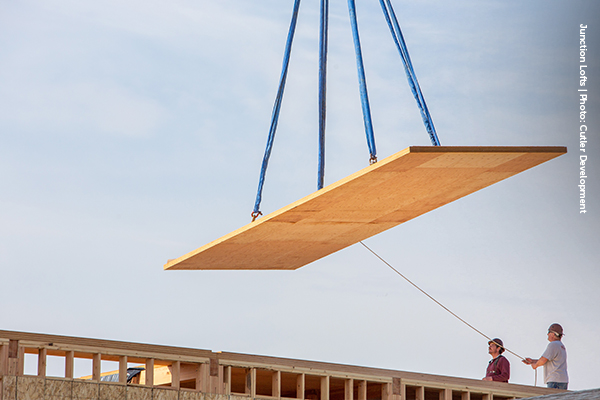
The 2026 State of the Nation’s Housing report from Harvard University’s Joint Center for Housing Studies found that while a wave of multifamily construction and steady levels of single-family homebuilding have eased the overall housing crunch in the United States, severe shortages of lower-cost housing remain. Light-frame and mass timber construction can play a key role in creating affordable housing options, and WoodWorks is supporting developers and design teams exploring alternatives to concrete and steel. Recent examples include:
- Affordable Housing Team Pursues First Mass Timber Project – An architect and developer evaluating a 5-story affordable housing project in Richmond, Virginia, received guidance from WoodWorks on construction speed, logistics, and manufacturer connections that supported first-time adoption of mass timber.
- Supporting Mass Timber Affordable Housing in Washington – By assisting a first-time tall wood contractor with cost benchmarking, procurement, installer selection, schedule savings, and trade impacts, WoodWorks helped advance two 8-over-1 mass timber affordable housing projects in Seattle.
- Landmark Affordable Housing Development in Vermont – WoodWorks helped a team designing a 1,400-unit, 8-story affordable housing project identify funding pathways and wood’s benefits related to sustainability and the regional forest economy, advancing Vermont’s first major mass timber affordable housing development.
A WoodWorks national online seminar in July, “Mass Timber Strategies for High-Performance Affordable Housing,” featured Scott and Molly Cutler of Cutler Development, a Des Moines, Iowa-based commercial real estate firm focusing on affordable urban infill and mixed-use projects. The webinar attracted 1,734 attendees. “I appreciated how accessible the Cutlers were with their content,” said one owner/developer who attended. “Often projects and developers are on a much larger scale, but we’re starting our foray into mass timber with smaller projects so it was great to hear the focus points. This was very applicable and inspiring content to new, smaller developers that are also in the affordable housing space.”
Affordable housing spans multiple high-priority construction segments in the SLB’s strategy, including 1–4 and 5–8 story multifamily projects, which offer a combined annual incremental lumber demand opportunity of 977 MM BF. The SLB’s investment in WoodWorks is critical to unlocking this opportunity by supporting project teams with expert technical guidance and resources.
Rothoblaas Workshop Expands SLB’s Faculty Development Model
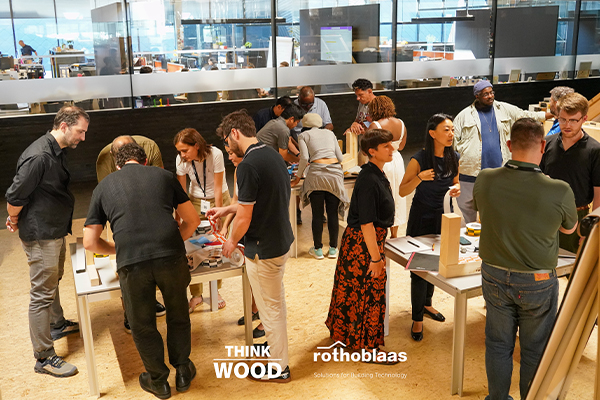
The Rothoblaas Timber Workshop for Educators marked a new kind of faculty development partnership for SLB—one that expanded the program’s disciplinary reach, deepened the technical content available to educators, and created a more cost-effective delivery model.
Hosted at Rothoblaas’s headquarters in Cortaccia, Italy, the workshop brought together 35 faculty participants from architecture, engineering, and construction management programs across the United States. It was the largest SLB-supported faculty development workshop to date and the first to fully integrate all three major AEC education audiences in one intensive training program.
The partnership model was especially valuable because Rothoblaas has a clear business interest in helping future design and construction professionals understand the role of its product lines in wood and mass timber construction. By placing its technical experts, facilities, and hands-on training infrastructure directly in front of faculty, Rothoblaas helped educators experience how mass timber systems move from design theory into real-world delivery.
Participants explored topics critical to successful timber construction, including structural connections, building envelope performance, acoustics, fire behavior, moisture management, and hybrid timber systems. The program also included hands-on exercises, full-scale demonstrations, site visits, and classroom-application discussions designed to help faculty translate advanced technical content into teachable material.
The workshop also demonstrated the value of industry partnerships as a scalable delivery model. Through favorable cost sharing with Rothoblaas, the SLB delivered the workshop at a cost per participant 27% below the average of the five faculty development workshops planned for 2026. Demand for the workshops is stronger than ever: After receiving 84 applications for 30 spaces in the workshop, the SLB increased participation to 35 faculty. Another workshop with Rothoblaas is planned next year, and SLB Education is looking to expand this model with other U.S. companies.
Five experienced faculty mentors supported participants throughout the program and will continue serving as a resource as educators incorporate wood and mass timber content into AEC curricula. This model extends faculty development beyond exposure—helping educators convert leading-edge technical training into applied teaching strategies that reach future architects, engineers, and builders.
AWC’s Key Wins Upheld in Final 2027 I-Codes Voting
The 2027 I-Codes cycle closed with every wood-favorable outcome secured by the AWC in prior hearings still intact, protecting lumber’s standing in construction and preserving new opportunities for expanded use nationwide.
Proposals that would have restricted wood use or complicated code adoption are now permanently off the table for the 2027 codes, while several proposals the AWC championed to expand wood’s use are locked in.
These wood-favorable updates include:
- Updated references to industry design standards.
- Updated span tables for lumber headers and rafters.
- Expanded provisions for continuity of fire-resistance supporting platform construction.
- Added references to ASTM D8391 for fire performance of wood-based floor framing and the ANSI/AWC Fire Design Specification for Wood Construction (FDS).
The AWC also blocked several proposals that would have limited where and how wood could be used, including:
- Collapsing the three-tier wildland-urban interface (WUI) class structure into a single class, limiting material options.
- A concrete-industry proposal that would have reduced the amount of exposed wood permitted in Type IV-B mass timber ceilings.
These outcomes matter because model codes establish the legal pathways that states and local jurisdictions rely on when approving building systems. Preserving favorable language protects existing lumber markets, while new provisions make it easier for designers, engineers, and code officials to use wood with confidence. The AWC’s focus now shifts to helping ICC implement these changes into the published 2027 I-Codes, while work on the 2030 cycle is already underway through ICC’s code action committees.
Think Wood Case Studies Boost Wood Design in High-Priority K–12 Segment

Education construction is a high-priority segment for the SLB, with more than 3,500 buildings constructed each year and an annual incremental lumber demand opportunity of 203 MM BF, and K–12 projects represent a subsegment with durable long-term demand. K–12 schools are built nationwide, and they’re often funded through stable capital programs and replicated across districts. Think Wood’s recent case studies in this segment demonstrate the value that wood construction can bring to these projects through fast construction timelines, improved student focus, and enhanced teacher well-being, leading to more wood specification among school design teams.
At the Packer Garden House, a four-level, 17,250-square-foot mass timber addition, the design team wanted to bring natural materials into the school, making exposed glulam columns and beams and CLT ceilings a win-win. “You’re not using extra material to add wood into the classroom; the classroom is already wood,” says WXY Architecture founding principal Claire Weisz. “Students love being in an environment where they’re surrounded by natural materials and, with CLT, you’ve already got 50% of the surfaces covered.”
The SLB and USDA Forest Service’s 2025 Mass Timber Competition: Building Sustainable Schools awarded funding to four K–12 schools that show wood construction can outperform conventional systems in cost efficiency, durability, and community impact. Think Wood’s K–12 resources inspire school districts, architects, builders, and other professionals with replicable design strategies that can help them bring wood’s benefits to their own projects and communities.
Spotlight
Alabama Joins Expanding Accelerator Program
The SLB’s Accelerator Cities Program continues to grow, unlocking new lumber demand in high-priority markets.
In partnership with the SLB and the USDA Forest Service, along with the U.S. Endowment for Forestry and Communities, the Alabama Forestry Foundation (AFF) has launched the Alabama Mass Timber Accelerator to identify and support project teams exploring mass timber. It’s a natural extension of the AFF mission: a chance to grow demand for Alabama’s forest products by putting them to work in the buildings the state needs most. Notably, AFF rallied direct financial commitments from 13 investors across the state—a clear signal of how much the industry itself sees at stake in this work.
Alabama joins a growing national cohort of participating Accelerators that (since 2022) includes Boston, New York City, Atlanta, Santa Monica, and Portland. The program connects municipal and state leadership, code and fire officials, developers, and design teams with technical, educational, and communications support—helping active development projects advance through the critical early phases of planning and design, while strengthening the broader case for lumber as a mainstream building material in taller and larger buildings.
“Alabama faces the same pressure many states are grappling with: a growing need for housing, delivered more quickly and cost-effectively, without sacrificing quality or sustainability,” says Chris Erwin, Executive Vice President of the Alabama Forestry Foundation. “Mass timber and other lumber-based structural systems offer a proven path forward, and this new Accelerator will put that potential into practice on real projects across the state.”
The SLB serves as the catalyst for the growing network of Accelerator Cities nationwide—and structuring these as public-private partnerships allows the SLB to share program costs with the USDA Forest Service and the U.S. Endowment for Forestry and Communities, extending the reach of available funding across more cities and states. To learn more and connect your local city officials with the SLB for guidance and resources, contact acceleratorcities@softwoodlumberboard.org.
Industry Resources
FEA's Housing Dashboard
FEA’s Housing Dashboard
These housing dashboards are provided compliments of Forest Economic Advisors (FEA).