

HIGHLIGHTS
The SLB’s Investments Are Critical for Both Developers and Lumber Producers
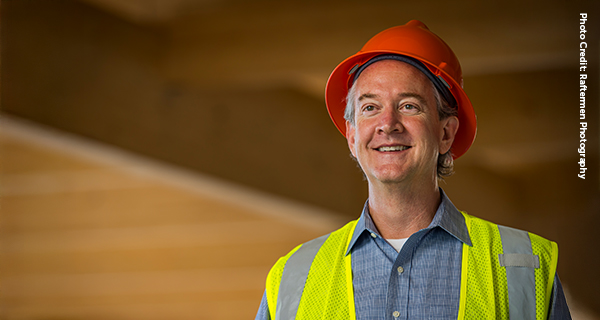
Jamestown’s Troy Harris wears two hats. As a forester, he oversees a timberland portfolio of nearly 90,000 acres in five states. As a commercial real estate developer, he’s focused on using innovative wood products to reduce the carbon footprint of his projects.
Recently nominated as the first public member on the SLB’s Board of Directors, Harris has already experienced firsthand how the SLB opens new markets for lumber producers and landowners, empowers developers to choose wood, and inspires a new generation of design professionals.
In a new SLB Insights article, Harris provides perspective on the SLB’s impact from both a forester and a developer’s perspective, describing how Jamestown’s mass timber 619 Ponce is a powerful example of the SLB’s “Niche to Mainstream” strategy in action—with early adopters like Jamestown helping to prove mass timber’s viability and unlock wider demand.
Program Updates
WoodWorks Accelerates Wood Use in Data Centers and Warehouses

WoodWorks is positioning lumber as a viable, scalable solution for warehouses, distribution centers, and data centers—segments that represent significant opportunity for incremental lumber demand.
Boosted by the boom in e-commerce, the warehouse segment represents nearly 180 MM BF in potential annual volume even with just 5% market share for wood, but that can scale much higher with more penetration: 552 MM BF at 13% market share and a ceiling of 3.5 BBF. Driven by the exponential growth in demand for generative AI, data center construction is projected to grow 22% in 2025 and another 15% in 2026.
Lumber’s sustainability credentials make it a strong fit for these segments. In a blog post making the business case for low-carbon building materials, Greg Bauer, Managing Director and Global Head of Development Management for Prologis, the world’s largest industrial real estate company, writes: “Mass timber is more sustainable and resilient, offering natural insulation and biophilic benefits, and it’s increasingly cost-competitive, making it a viable alternative for modern industrial design.”
Since touring the world’s first mass timber data center in Sweden, WoodWorks has been studying the metrics and potential of the data center market, building code issues, drivers for wood use, and construction challenges. WoodWorks is now supporting multiple data center projects in the United States. Some projects have begun incorporating mass timber, starting with the administrative buildings on data center campuses.
Industrial design teams increasingly turn to WoodWorks for guidance on mass timber wall panels, hybrid systems, and shear wall design. For developers, WoodWorks extends support beyond engineering, helping shape internal standards, providing data on cost and performance, and building confidence in wood’s advantages. As a trusted adviser to several companies across the country exploring wood solutions, WoodWorks is laying the groundwork for broader industrial adoption—positioning lumber for growth as warehouse and data center construction gains momentum nationwide.
AWC Secures More Key Wins in 2027 I-Code Hearings
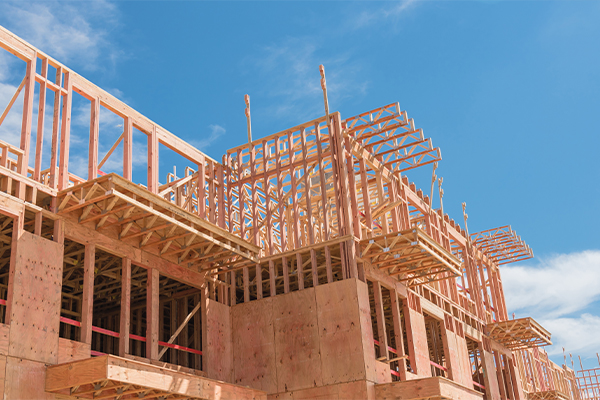
The International Code Council’s I-codes form the basis of building safety codes in all 50 U.S. states, so ensuring the codes remain receptive and favorable to lumber is a major industry priority. The AWC has scored key wins for the industry throughout the 2027 I-Code cycle, which is a multiyear process with several rounds of public hearings. The most recent hearing, the Group B Committee Action Hearing 2 in late October, was no exception. The AWC defeated a proposal that would have rolled back previous code wins and saw the approval of several important proposals that clarify and decrease the cost burden for wood frame construction.
The Group A and B hearings saw many favorable results for the industry, including the following:
- Disapproval of a concrete and masonry industry proposal to reverse the allowance for 100% exposed mass timber ceilings introduced in the 2024 IBC.
- Approval of proposals clarifying an available compliance path for achieving fire-resistance ratings, eliminating unnecessary hangers and labor—and making wood an even more cost-efficient choice in 4- and 5-story multifamily buildings.
These and other results are important victories for the lumber industry that help ensure wood construction is safe and accessible in the codes. The AWC’s work to make sure wood is fairly treated in building codes and standards is vital to protecting markets for lumber. The final 2027 I-Code Public Comment Hearing is in April 2026.
Shaping Tomorrow’s Demand: Student Engagement as a Strategic Advantage
The future of softwood lumber demand hinges not only on today’s projects, but also on the expectations of tomorrow’s architects, engineers, and builders—today’s students. As other material industries deepen their long-standing postsecondary engagement, SLB Education is seeing to it that wood earns its place in the minds of tomorrow’s decision-makers—early, confidently, and at scale.
Construction-management programs represent the next major opportunity to make sure building designs don’t default to concrete or steel because of a lack of trained contractors, an issue identified in SLB and WoodWorks research on obstacles to mass timber construction. With fewer than 10% of CM programs currently teaching mass timber, early exposure is critical.
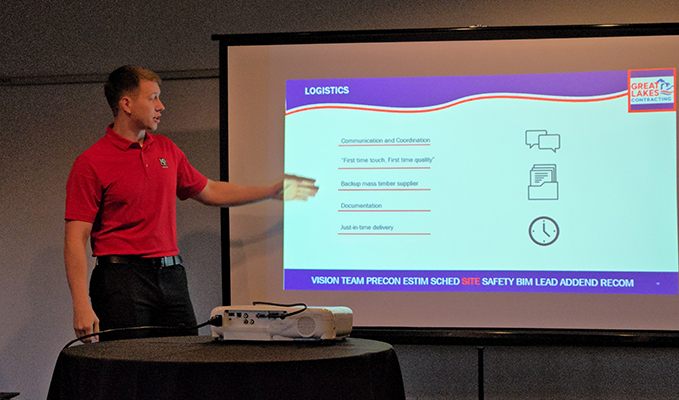
This fall, the SLB launched the first mass timber construction-management challenge (pictured above) at the Associated Schools of Construction Great Lakes Region 3 competition—an influential recruiting ground for national contractors. The strong response demonstrated how effectively competitions can introduce wood to future estimators, project managers, and site supervisors. Over the next year, the SLB will work to expand the mass timber challenge to more of the seven regional competitions across the country, reaching thousands of CM students where career pathways are actively being shaped.
Together, these investments in student engagement create a powerful flywheel: Interest is sparked, hands-on familiarity deepens. Graduates enter practice confident in wood’s capabilities with technical grounding to dispel bias, so wood isn’t confined to the residential scale by default. When students enter the workforce seeing wood as a reliable, high-performance option, demand grows naturally—and the industry benefits from a generation that views wood solutions not as an alternative, but as mainstream.
Think Wood and WoodWorks Jointly Feature Innovative Modular Multifamily Project in Montana
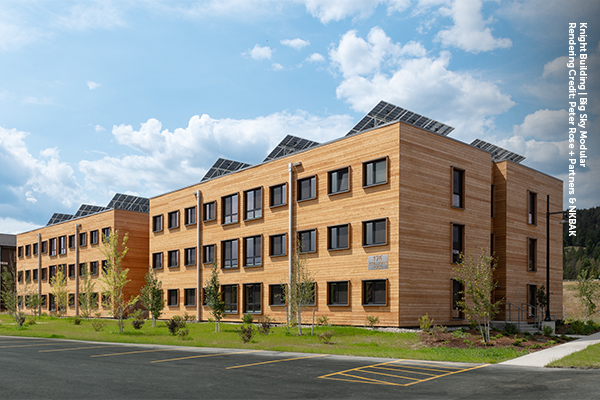
Architects, engineers, developers, and general contractors each have plenty to learn from Bucks T-4, a modular mass timber workforce housing project in Big Sky, Montana. The first large-scale project of its kind, bringing 96 workforce housing units to an area with high labor and construction costs, the project provides insights on how design teams can make modular housing that’s not just affordable, but also elegant and efficient. Multifamily housing—particularly affordable and workforce housing projects—are one of the lumber industry’s highest-growth opportunities, with multifamily 1- to 8-story projects representing 977 MM BF in potential annual demand.
Think Wood and WoodWorks are leveraging this compelling and educational project with complementary resources that illustrate its innovative features. Think Wood’s case study highlights the project’s design story and how wood made it possible, while a WoodWorks webinar features the project team diving into the technical details and how the project was constructed. A WoodWorks Innovation Network entry spotlights the project’s consultants and helps firms network to learn more. Think Wood’s work reaches widely across design and development audiences, and WoodWorks addresses design and technical details—an exemplary illustration of SLB program collaboration.
A recent converted projects analysis by the SLB shows that, on average, projects that have both a Think Wood and WoodWorks touchpoint average +0.2 BF/SF of incremental lumber for light frame and +2.3 BF/SF incremental lumber for mass timber over projects with a WoodWorks touchpoint alone. To increase touchpoints for both programs, a cobranded Think Wood and WoodWorks email will feature each of these resources—boosting engagement to drive more lumber specification and project support requests.
Spotlight
Portland and Santa Monica Join Accelerator Cities Program
The SLB and the USDA Forest Service are expanding the Accelerator Cities Program—laying the groundwork for broader adoption of wood construction in key markets, helping to drive demand for lumber and increase market share in multifamily and nonresidential construction.
The City of Portland Housing Bureau in Oregon has launched a Pilot Mass Timber Feasibility Studies Grant Program to explore how mass timber construction can support the city’s sustainability goals and affordable housing priorities. With $450,000 in combined funding from the SLB, Forest Service, and PHB, the program will support several active development projects using mass timber in multifamily housing and related commercial projects.
The City of Santa Monica in California is launching the Santa Monica Mass Timber Accelerator, an initiative designed to evaluate and expand the use of sustainable building materials across local development projects. Backed by $115,000 in funding from the SLB, Forest Service, and the city, the program will award competitive grants to design teams studying the use of mass timber in residential, commercial, and institutional construction.
These upcoming programs build on $1 million in investments (leveraging $200,000 from the SLB) in approved and active accelerators in Boston, New York City, and Georgia that have directly supported more than 40 innovative wood projects. They’re also the latest example of the SLB’s alliance with the Forest Service. Since formalizing their collaboration through a memorandum of understanding in 2015, the SLB and Forest Service have co-invested nearly $100 million in programs and competitions that expand markets for softwood lumber and position it as a sustainable building solution.