

HIGHLIGHTS
PROGRAM UPDATES
The AWC Advances Key Lumber Provisions in 2027 I-Code Process Largest SLB-Supported Faculty Workshop to Date Builds Wood Design Teaching Capacity GC Engagement Helps Advance Stalled Mass Timber Projects Outdoor Living Case Studies Inspire Wood Use in Both Homes and BuildingsINDUSTRY RESOUCES
FEA's Housing DashboardProgram Updates
The AWC Advances Key Lumber Provisions in 2027 I-Code Process
The rules that govern how America builds are updated every three years. When those rules change, lumber markets can expand or shrink—and not always for technical reasons. That’s why the AWC is active at every stage of the International Code Council (ICC) process.
At the ICC’s final Public Comment Hearings in April, the AWC secured wins that directly protect and expand wood product markets. Lumber span table updates and new platform framing provisions give builders and engineers broader design options, and more reasons to choose lumber. A new reference to the AWC’s Fire Design Specification creates a clear additional pathway for heavy timber construction.
The AWC also stopped several rollbacks. A concrete industry push to limit exposed wood in mass timber buildings failed. Proposals that would have collapsed wildfire zone classifications, effectively shrinking options for wood construction in fire-prone regions, were defeated.
In addition, the AWC advanced new language protecting the structural grading criteria for salvage sawn lumber, ensuring established grading standards can’t be undermined in the code.
Final voting for the 2027 I-Codes took place in late May, and the ICC is expected to release final results later this year.
The SLB supports the AWC’s technical code development efforts because building codes have a direct impact on lumber and wood product use. Assessment funds do not support lobbying or legislative advocacy activities. This information is included because code development outcomes are important to the lumber industry and directly affect market opportunities for wood products.
The AWC’s critical building code work would not be possible without sustained investment in technical expertise, research, and relationships built over years. Every provision the AWC protects or advances has a direct impact on where and how lumber can be used.
Largest SLB-Supported Faculty Workshop to Date Builds Wood Design Teaching Capacity

This month, 30 architecture educators from 24 schools across 17 states came together in Auburn, Alabama, for the largest faculty development workshop the SLB has supported to date. The program gave architecture educators a deeper understanding of mass timber across the full value chain, from forestry and harvesting to milling, manufacturing, design, and construction.
Faculty capacity remains one of the biggest bottlenecks to expanding wood-focused content in AEC programs. Many educators are interested in teaching more about wood, but lack the time, experience, or confidence to build that content on their own. Faculty development workshops are one of the fastest and most efficient ways to close that gap—giving educators practical knowledge, real project context, and teaching confidence they can bring back to the classroom right away.
Hosted by Leers Weinzapfel Associates in collaboration with Auburn University, the workshop was led by Tom Chung, a leading mass timber architect, and grounded in real project and industry experience. Participants visited Woodlands Timber’s harvesting operation in Troy, toured Rex Lumber’s sawmill, and saw CLT manufacturing firsthand at SmartLam in Dothan. The program also included visits to completed projects and academic sites, helping connect the full chain from forest to finished building.
For the SLB, that is the multiplier. When faculty return to campus better prepared to teach wood, the impact reaches future architects, engineers, and builders through coursework, studios, and long-term curriculum integration.
“The workshop was an immersive educational experience,” said Lyannie Tran, Assistant Professor of Architecture at Cal Poly Pomona. “Interacting with workshop participants around the country and seeing the transformation from farmed forest to wood to mass timber production to built form was an inspiring adventure I will never forget.”
GC Engagement Helps Advance Stalled Mass Timber Projects
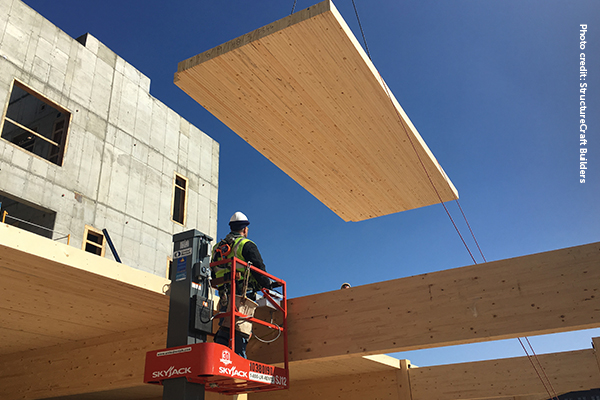
When a WoodWorks-supported mass timber project fails to go to construction, cost is the most frequently cited cause. But in many cases, the underlying issue is contractor uncertainty. General contractors (GCs) unfamiliar with mass timber often inflate bids to account for perceived risk, driving up project costs and stalling otherwise viable developments. This challenge was also reflected in an SLB and WoodWorks study examining obstacles preventing increased adoption of mass timber.
To help address this issue, the WoodWorks Construction Management (CM) team is reaching out proactively to mass timber projects at the “Waiting for Construction” stage. In Q1, the CM team supported 22 mass timber projects nationwide, providing early-stage constructability guidance and contractor education. They helped teams navigate challenges such as system coordination, erection logistics, and bid preparation, particularly for contractors new to mass timber. The team also strengthened alignment between GCs, erectors, and suppliers while supporting active construction troubleshooting.
WoodWorks increased support for this effort last year by deploying a second staff member to the CM team full-time. In addition to project support, WoodWorks provided construction management training to more than 1,000 participants last year and the program has established 75 training centers nationwide.
GCs educated by WoodWorks frequently go on to bid on and construct additional mass timber projects on their own, boosting the pool of qualified contractors and even supporting WoodWorks by joining as partners. Construction speed is a key benefit of mass timber and, without qualified and trained installers, that advantage could erode quickly. Through site visits and direct engagement, WoodWorks improves GCs’ execution readiness and helps move projects closer to construction.
Outdoor Living Case Studies Inspire Wood Use in Both Homes and Buildings
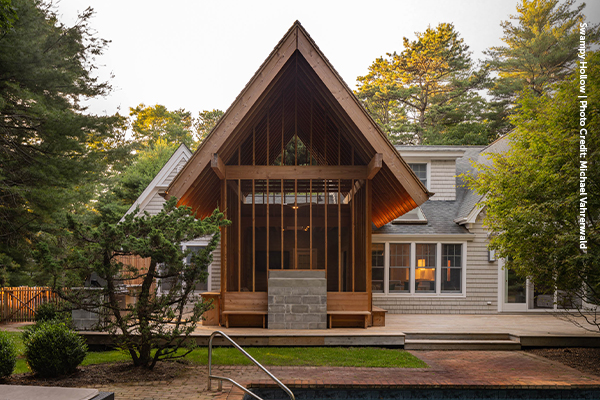
Think Wood’s single-family content plays an important role in defending wood’s position in the residential market by reinforcing its relevance beyond conventional framing, encouraging engaged residential users to consider additional uses of wood, such as outdoor and appearance applications. To coincide with the beginning of outdoor living season, Think Wood published a collection of five residential case studies featuring beautifully designed wood porches and decks that celebrate wood’s versatility and aesthetic appeal in outdoor applications.
To capture residential contractors’ attention at a time when clients are reaching out about outdoor projects, Think Wood also conducted a paid digital media campaign with ads targeting the residential contractor audiences of the Journal of Light Construction and Professional Deck Builder. These ads directed viewers to Think Wood’s Outdoor Living page, which includes marquis examples of outdoor wood applications and highlights the performance and aesthetic benefits of wood decking products compared with composites.
Residential content is an interest driver across single-family and commercial audiences, complementing Think Wood’s storytelling around multifamily and nonresidential wood design by increasing engagement that leads to a higher likelihood of future wood use. For example, the Single-Family Home LookBook, Vol. 2 was one of Think Wood’s most popular resources in Q1—and it generated three commercial project assistance questions, all related to multifamily or hotel projects informed by single-family trends.
Spotlight
AI Adoption Supports SLB’s Strategic Priorities
Across SLB-supported programs, the operating environment is becoming more data-driven, faster-moving, and more contested. Artificial intelligence allows the SLB and its programs to turn technical expertise and institutional knowledge into market influence more efficiently. In response to this opportunity, the SLB and its programs have moved from AI awareness into active implementation. Collectively, they are using AI to reduce administrative burden, improve content quality, and align more closely with the SLB’s strategic priorities.
The pattern across programs is consistent: AI delivers the most value in tasks that are high-volume, repeatable, and document-intensive—drafting, summarizing, reporting, and media optimization. For example:
- The SLB has moved its quarterly executive dashboard and annual ROI reporting into AI-enabled tools, reducing human error and cost by approximately $120,000 annually—dollars that can now go toward initiatives that grow demand for lumber.
- The SLB turned FEA’s 2026 Construction Market Outlook into a custom GPT, providing an easy-to-use interface that makes the underlying data more actionable and accessible to all SLB-funded programs and partners.
- Think Wood is applying AI to media performance and spend optimization. The efforts have reduced agency media and metrics monitoring time by 90% through AI-assisted campaign management. Performance is also improving, with the cost per ad click on Think Wood’s continuing education ads down 38% year-over-year.
As construction becomes increasingly data-driven, AI enables SLB programs to scale expertise, improve responsiveness, strengthen market access, and position wood more competitively in the next generation of building design, sustainability, and code development.
Industry Resources
FEA's Housing Dashboard
FEA’s Housing Dashboard
These housing dashboards are provided compliments of Forest Economic Advisors (FEA).
View the June Housing Dashboard