

HIGHLIGHTS
PROGRAM UPDATES
WoodWorks Supports Lumber Specification in Light-Frame Projects The SLB Brings Wood Design Education to 350 Future Architects at AIAS Forum The AWC Accelerates U.S. Mass Timber Construction Through Code Education Think Wood Features Repeatable Mass Timber Student HousingINDUSTRY RESOUCES
FEA’s Housing DashboardAccelerator City Initiatives Align Public and Private Support for Lumber-Based Construction

SLB-supported Accelerator City initiatives in New York City and Georgia recently held celebration events to recognize 10 innovative wood buildings selected for program support. Developed in partnership with the USDA Forest Service and supported by the U.S. Endowment for Forestry and Communities, the Accelerator Cities Program provides targeted funding, technical assistance, and local industry engagement to help high-opportunity cities pilot and scale lumber-based building systems.
Held at the New York City Center for Architecture, the final event for the second cohort of the NYC Economic Development Corporation’s Mass Timber Studio included presentations and poster displays from the seven selected design teams. The event also included notable and encouraging engagement from the city’s Department of Buildings and Fire Department, with DOB Commissioner Ahmed Tigani noting his agency’s commitment to work with the design teams in the room.
“We have to step up to figure out how we build the foundation for you to grow,” he said. “How do we use the public tools in our domain? Whether it’s the rules and regulations, our relationship with the financial sector, the inspection process, or the administrative process—to make it easier to take these good ideas and bring them to more places” in the city.
The Georgia Forestry Foundation also wrapped up its Mass Timber Hub Series with an event to celebrate the three standout projects selected in its 2025 cohort. The program, which has expanded beyond Atlanta to include Mass Timber Hubs in Columbus, Savannah, Athens, and Macon, is expected to select three additional projects for a 2026 cohort.
The SLB’s city-level approach—aligning code implementation, workforce readiness, developer engagement, and partner activity in metropolitan areas with the strongest near-term conversion potential—is a key part of the implementation of the “From Niche to Mainstream” strategic plan, enabling repeatable project wins that can be scaled to additional markets. Backed by $1 million from the USDA Forest Service, $500,000 from the SLB, and $250,000 from the U.S. Endowment for Forestry and Communities, the Accelerator Cities Program will continue to deploy targeted funding to grow high-impact urban markets in 2026.
Call for Nominations: The Softwood Lumber Board Seeks Candidates
The Softwood Lumber Board seeks nominations for three domestic softwood lumber manufacturers and one importer interested in candidacy for Board seats coming open in January 2027. The deadline for nominations is April 8, 2026.
The SLB is seeking nominees to fill four seats for Directors whose terms expire on December 31, 2026:
- Three domestic manufacturers:
- Two large companies representing the U.S. South;
- One company of any size representing the U.S. West;
- One importer:
- One small company representing importers from any region.
Members serve for a three-year term and may serve for a maximum of two consecutive terms. To learn more about qualifications, the nomination process, and the timeline, visit the Call for Nominations.
Program Updates
WoodWorks Supports Lumber Specification in Light-Frame Projects

Light-frame construction remains central to the SLB’s long-term strategy, particularly in mid-rise multifamily (such as the WoodWorks-supported Seagaze Apartments in Oceanside, California, pictured above) and urban infill development. In 2025, 66% of WoodWorks’ directly influenced projects were light-frame, representing 354 MM BF of lumber. Regional Directors supported decision-makers at pivotal moments to prevent material substitution, resolve permitting friction, and protect project economics.
Key interventions included:
- Preserving light-frame construction on a nine-building affordable housing development with zero lot lines by identifying compliant UL-listed light-frame wall assemblies that maintained fire separation without shifting to higher-cost materials.
- Advising on sprinkler, concealed space, and construction type strategies in 3-over-1 projects to eliminate unnecessary podium construction and reduce fire-resistance costs.
- Clarifying gypsum continuity and shaft termination requirements to avoid rework and schedule delays.
- Introducing strategies and details for addressing shrinkage with all-wood structural systems, a concern in large light-frame projects.
Together, these actions preserved incremental board feet in cost-sensitive projects and reinforced light-frame wood as a repeatable, scalable solution.
The SLB Brings Wood Design Education to 350 Future Architects at AIAS Forum
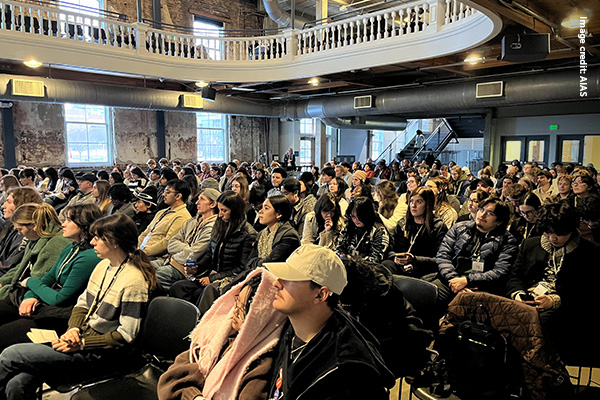
In January, the SLB sponsored the American Institute of Architecture Students (AIAS) Forum—the largest annual gathering of architecture students in the United States. The event convened 350 students representing 55 schools from across the country.
A highlight was a hands-on mass timber workshop that moved wood beyond drawings and theory. Students worked directly with structural components, power tools, and fasteners, assembling elements themselves and gaining a practical understanding of product types and connection systems. The experience provided tangible insight into how mass timber systems come together in real buildings.
Students also toured T3 RiNo, one of the latest completed projects in developer Hines’ T3: Timber, Transit, Technology series of commercial mass timber buildings, which includes 23 projects completed, in design, or under construction. Walking through the completed Class A office building demonstrated the scale, structural performance, and architectural quality achievable with lumber in a competitive commercial setting.
The Forum’s keynote was delivered by Jessie Johnson of DLR Group, the principal architect responsible for T3 RiNo. She traced the project from early design through coordination and on-site assembly, giving students a comprehensive view of the mass timber project lifecycle and the professional pathways involved in delivering these buildings.
By grounding wood design education in direct experience and built examples, the SLB is helping ensure future architects see mass timber not as aspirational, but as a viable and competitive solution for nonresidential construction.
The AWC Accelerates U.S. Mass Timber Construction Through Code Education

At the end of 2025, 44 states (30 statewide and 14 with adopting jurisdictions) had adopted the mass timber provisions in the 2021 or 2024 International Building Code (IBC). Mass timber’s inclusion in the IBC is still fairly new, and the American Wood Council continues to play a leading role in supporting states and jurisdictions as they consider, adopt, and implement the provisions.
A major focus of the AWC’s effort is ensuring that building code officials and fire service leaders have the technical confidence and familiarity needed to fully assess mass timber construction. The AWC’s recent work in New York City demonstrates the program’s expertise and ability to meet the specific needs of each regulating area.
New York City has a unique approval process for code adoption, and as a result, a coordinated effort between the AWC’s codes team and fire service engagement teams has been critical. The codes team had established relationships in New York City, and after hearing concerns about a potential limited adoption of the IBC’s mass timber provisions, led education presentations for the city’s code committee to address misconceptions and clarify relevant testing and performance standards. This further solidified the AWC’s role as a technical expert and resource for the committee as they continue to deliberate on the mass timber provisions.
At the same time the city’s code committees deliberated, the AWC’s fire service engagement team was actively meeting with and supporting the fire department because the mass timber proposals are unlikely to pass without the department’s support. In January, the AWC joined the New York State Fire Chiefs’ Association at the Long Island Fire and EMS Expo, leading a training seminar and meeting with a key former member of the New York City Fire Department to discuss strategies for communicating the safety of mass timber with the department.
Supporting the adoption of mass timber provisions across the U.S. helps expand where wood construction can be used, opens new markets, and provides standardized pathways for mass timber projects. Educating building code officials and fire departments is a critical part of this, and the AWC’s work in New York City is just one example of the places that the AWC is listening and responding to the educational needs of jurisdictions around the country.
Think Wood Features Repeatable Mass Timber Student Housing
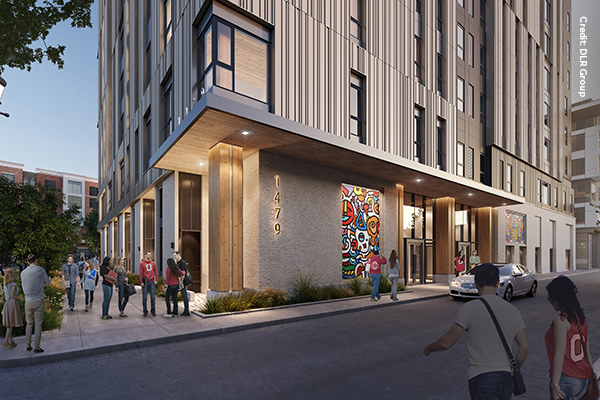
A 13-story mass timber tower under construction at The Ohio State University is demonstrating that tall wood student housing can not only pencil out—it can also be a cost-effective and ultimately repeatable kit-of-parts solution for market-rate student housing.
Think Wood’s profile of 9th and High features Mark Bell, CEO of Harbor Bay Ventures, which previously gained experience with INTRO, one of the largest completed mass timber projects in the United States. He describes mass timber’s architectural appeal and lower carbon footprint, as well as its offsite prefabrication advantages. “When done right, mass timber lets us build the same building with less labor and roughly 25–30% faster than a conventional post-tension concrete equivalent,” he says. “When affordability and housing are in crisis, that kind of speed isn’t just a nice-to-have—it can be part of the solution.”
Student housing was a strong performer for lumber-based construction in 2025, with WoodWorks supporting a steady stream of new student housing projects—many using light-frame wood systems or hybrid approaches that combine light-frame with mass timber. Low-rise and mid- to high-rise multifamily projects are key areas of focus in the SLB’s long-term strategy, with 5- to 8-story projects representing an annual incremental lumber demand opportunity of 307 MM BF. Think Wood’s case studies in this segment show that there is a significant opportunity for both light-frame and mass timber systems to gain ground.
Spotlight
FEA: Senior Housing Represents 1.2 BBF Annual Incremental Opportunity
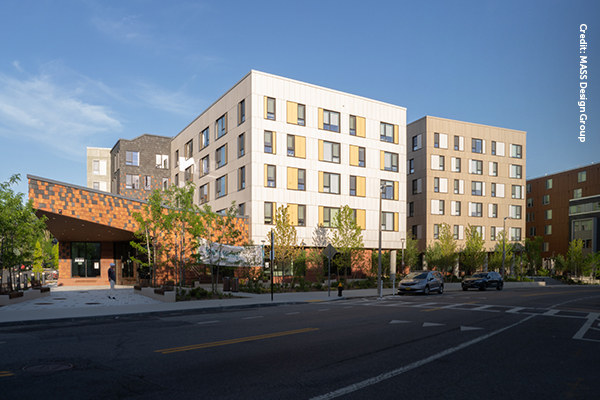
Senior housing represents one of the clearest structural growth opportunities of the next decade. The 80+ population surge, rising longevity, and aging facilities are creating a historic supply gap that current construction levels cannot meet. This gap creates a clear, scalable opportunity for lumber-based construction systems—particularly light-frame solutions.
To maintain roughly 90% occupancy, the U.S. must deliver more than 100,000 senior housing units annually through the 2030s—nearly four times today’s pace of 26,000 units. Wood is already the dominant structural system in this sector:
- Wood holds approximately 82% overall senior housing market share.
- Wood has an 86–90% share in senior apartments and active adult segments.
- About 83% of senior housing projects are 1–4 stories, where light-frame wood is most cost-effective. (The light-frame JJ Carroll Redevelopment, pictured above, provides 142 affordable senior housing units in a 5-over-1 project.)
If construction scales to meet projected demand between 2027 and 2035, FEA estimates incremental lumber demand could exceed 1.2 billion board feet annually, without assuming additional market-share gains.
WoodWorks plays a critical role in correcting the misconception that senior housing cannot use wood, showing design teams how most senior housing can utilize a Type III, IV, or V code pathway. WoodWorks technical experts can assist the architect and engineering teams in navigating these project-specific decisions. Since 2020, WoodWorks has assisted on more than 100 senior living projects totaling 14 million square feet, with more than 65 already built.
Industry Resources
FEA's Housing Dashboard
FEA’s Housing Dashboard
These housing dashboards are provided compliments of Forest Economic Advisors (FEA).
View the February Housing Dashboard
View the March Housing Dashboard